PCA9674D
Remote 8-bit I/O expander for Fm+ I2C-bus with interrupt
The PCA9674 and PCA9674A provide general purpose remote I/O expansion for most microcontroller families via the two-line bidirectional bus (I²C-bus) and are parts of the Fast-mode Plus (Fm+) family.
The PCA9674/74A is a drop-in upgrade for the PCF8574/74A providing higher Fast-mode Plus I²C-bus speeds (1 MHz versus 400 kHz) so that the output can support PWM dimming of LEDs, higher I²C-bus drive (30 mA versus 3 mA) so that many more devices can be on the bus without the need for bus buffers, higher total package sink capacity (200 mA versus 100 mA) that supports having all LEDs on at the same time and more device addresses (64 versus 8) are available to allow many more devices on the bus without address conflicts.
The devices consist of an 8-bit quasi-bidirectional port and an I²C-bus interface. The PCA9674/74A have low current consumption and include latched outputs with 25 mA high current drive capability for directly driving LEDs.
They also possess an interrupt line (INT) that can be connected to the interrupt logic of the microcontroller. By sending an interrupt signal on this line, the remote I/O can inform the microcontroller if there is incoming data on its ports without having to communicate via the I²C-bus.
The internal Power-On Reset (POR) or Software Reset sequence initializes the I/Os as inputs.
Remote 8-bit I/O expander for Fm+ I2C-bus with interrupt
| Type number | Package | I2C-bus interface | Number of bits | Source Current per bit(mA) | I2C-bus(kHz) | Operating voltage(VDC) | Weak Pull-Up Current Source | Max Sink Current per bit(mA) | # of Addresses | Max Sink Current, per package(mA) | Reset input pin | Enable | Operating Temperature(Cel) |
|---|---|---|---|---|---|---|---|---|---|---|---|---|---|
| PCA9674D | SOT162-1 (SO16) | Fast Mode Plus 30 mA SDA outputs for 4000 pF bus | 8 | 0.1 | 1000 | 2.3~5.5 | yes | 25 | 64 | 200 | no | -40~85 | -40~85 |
| Package Version | Package Name | Package Description | Reference Codes | Issue Date |
|---|---|---|---|---|
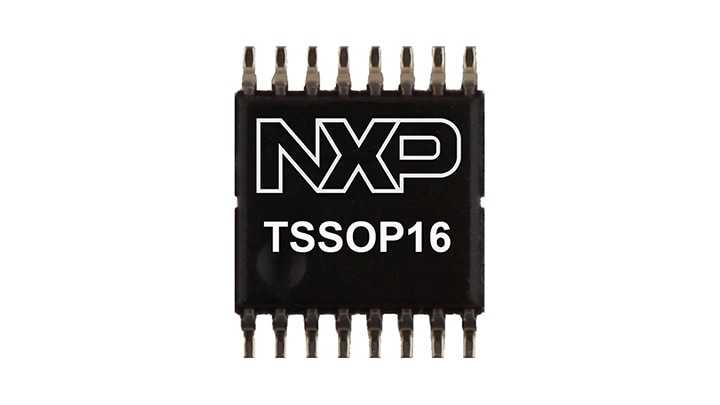
| SOT162-1 | SO16 | plastic small outline package; 16 leads; body width 7.5 mm | MS-013 (JEDEC); 075E03 (IEC); | 2003-02-19 |
| Type number | Orderable part number | Chemical content | RoHS | Leadfree conversion date | RHF | IFR (FIT) | MTBF (hours) | MSL | MSL LF |
|---|---|---|---|---|---|---|---|---|---|
| PCA9674D | PCA9674D,512 | PCA9674D | Always Pb-free | 2.0 | 5.0E8 | 1 | 2 | ||
| PCA9674D | PCA9674D,518 | PCA9674D | Always Pb-free | 2.0 | 5.0E8 | 1 | 2 |
| File name | Title | Type | Format | Date |
|---|---|---|---|---|
| PCA9674_PCA9674A | Remote 8-bit I/O expander for Fm+ I2C-bus with interrupt | Data sheet | 2011-09-29 | |
| AN10441 | Level shifting techniques in I2C-bus design | Application note | 2007-06-20 | |
| AN256 | PCA9500/PCA9501 provides simple card maintenance and control using I²C-bus | Application note | 2009-03-23 | |
| AN10814 | Driving stepper motors using NXP I2C-bus GPIO expanders | Application note | 2011-10-24 | |
| 75016543 | Create smarter, more efficient white goods; An industry-leading portfolio of cost-effective, power-saving solutions for major home appliances | Brochure | 2008-06-01 | |
| 75016535 | Versatile, easy-to-use GPIO expanders; NXP 4/8/16-bit I2C/SMBus GPIO expanders PCA9536/54/54A/55 | Leaflet | 2008-08-01 | |
| 75017424 | NXP I2C-bus solutions 2013: Smart, simple solutions for the 12 most common design concerns | Leaflet | 2013-05-23 | |
| UM10204 | I2C-bus specification and user manual | User manual | 2007-06-26 | |
| UM10206 | I2C Demonstration Board 2005-1 Quick Start Guide | User manual | 2006-06-13 | |
| UM10267 | PCA9698 demonstration board OM6281 | User manual | 2008-09-26 | |
| UM10204_JA | I2C-bus specification and user manual | User manual | 2013-04-03 |
Sample orders normally take 2-4 days for delivery.
If you do not have a direct account with NXP our network of global and regional distributors is available and equipped to support you with NXP samples. As a NXP customer you also have the option to order samples via our sales organisation.
Do you want to ask technical questions to an NXP expert?
Please select one of the following options:
Follow us