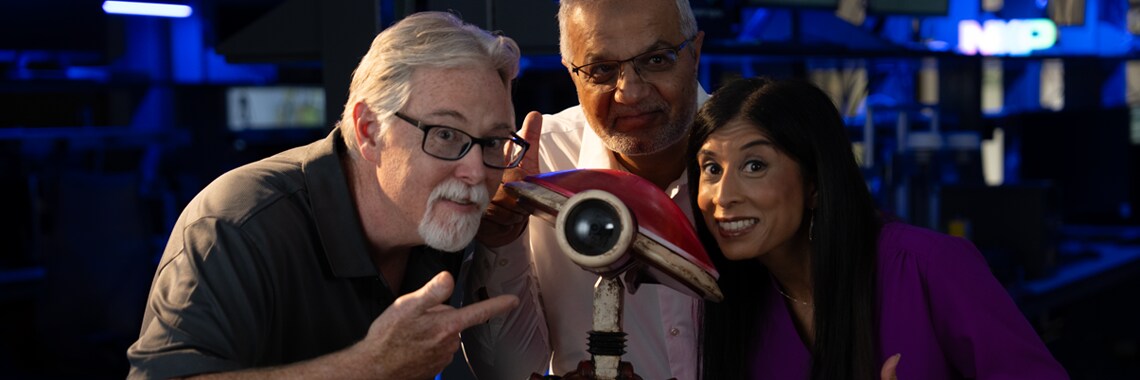
We're back with a new season of Conversations at the Edge (CATE),
and this time we’re diving into the fast-moving world of mobile
robotics. Last season, we stirred the pot with Matter in
smart homes, but now we’re diving deep into the machines that are rolling into warehouses, hospitals, farms and
maybe even your local delivery service.
And what's our first mobile robotics topic for discussion? The distributed revolution in mobile robotics. If that
sounds grand, it’s because it is. Centralized “brains” are giving way to distributed intelligence where sensors,
processors, and controllers all share the load. For developers, this shift changes how you design architectures,
plan for safety and think about scaling your platform.
And I’m not alone on this journey.
Meet the New Co-hosts
To keep it fresh, I’ve got two brilliant co-hosts on board.
Together, Altaf and Iain keep me honest by challenging my assumptions and providing decades of insight into what it
really takes to build robots that move, think and survive in the wild.
Episode 1: MVPs are a Trap
We poked the bear in our kickoff episode. Minimum viable products (MVPs) may sound harmless, but in robotics, they
can trap you. If you design for “just enough to demo,” you’ll hit a wall when it’s time to scale.
Instead, look to platforms. Here, modularity and scalability let you add new sensors, swap in higher-performance
compute, and layer on revenue-generating features without having to start over. In this episode, we showcased our
B3RB buggy reference design, which runs ROS 2 and demonstrates how distributed compute between a main processor and
companion microcontrollers create a scalable platform. The takeaway for developers: rather than build one-off
products, build architectures that can evolve for years to come.
Watch Now: Conversations at the Edge Season 2, Episode 1
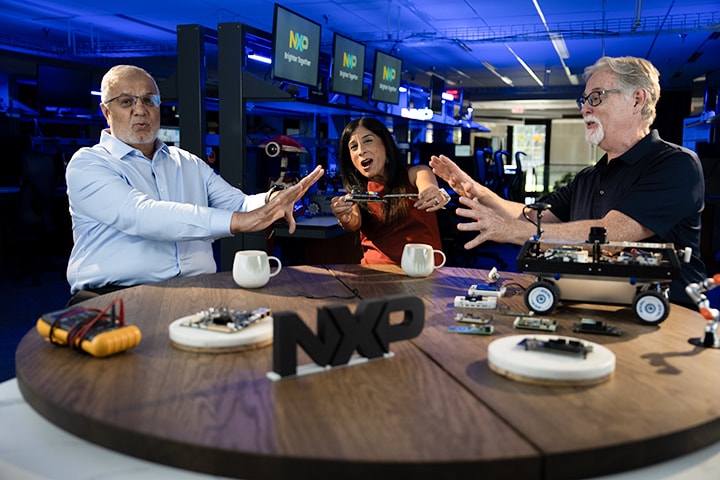 In Conversations at the Edge S2E1, Sujata, Iian and Altaf offer a better development
strategy for mobile robotics.
In Conversations at the Edge S2E1, Sujata, Iian and Altaf offer a better development
strategy for mobile robotics.
Episode 2: You Can’t Go to Market with a Raspberry Pi
We love Raspberry Pi for tinkering, but this is not the path to production robotics. The truth is, industrial robots
need long-term
supply, safety certifications, and hardened security. Prototyping boards for consumer applications won't provide
that.
Why? Developers need silicon that’s designed for real environments. For example, i.MX RT crossover MCUs
for drones,
automotive-grade processors with lockstep cores and secure elements and full reference designs integrate motor
control, battery management and connectivity. These give you a launchpad for market-ready systems without the
headache of trying to scale hobby boards.
Watch Now: Conversations at the Edge Season 2, Episode 2
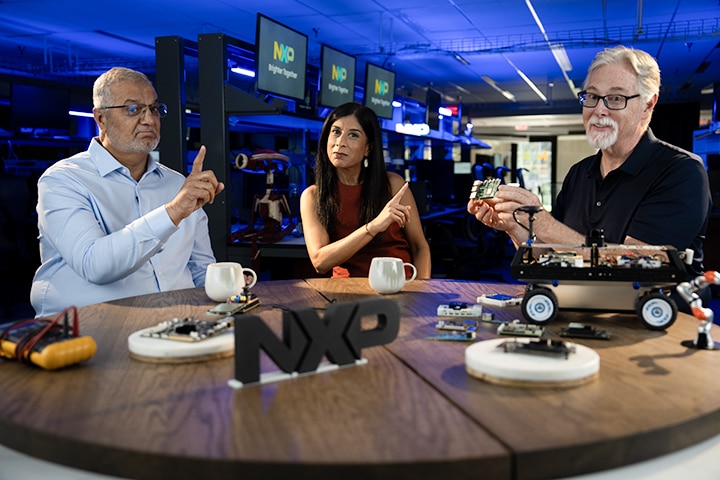 In Conversations at the Edge S2E2, the team discusses why developers need to think
beyond Raspberry Pi.
In Conversations at the Edge S2E2, the team discusses why developers need to think
beyond Raspberry Pi.
Episode 3: Mobile Robotics, AI and Your Mom
Yes, we really went there. As in, Iain tied a lesson from his mom, “be home by dark,” to AI. The analogy? Let your AI
explore but always set boundaries.
The three trends we called out in this episode are shaping robotics today:
- Agentic AI: robots that don’t just perceive, but act, such as detecting. For example, detecting a fire and
triggering a response
- Hardware safety: processors supervising processors, cutting power to motors if limits are exceeded
- Edge intelligence: neural accelerators like those in i.MX 95
that push decisions closer to the sensors for faster, more autonomous responses
For developers, this translates to designing systems where intelligence is layered, supervised and distributed across
the architecture. And if you still think AI is “just software,” our NavQPlus reference design — running Linux, vision pipelines and
dual neural accelerators — proves otherwise.
Watch Now: Conversations at the Edge Season 2, Episode 3
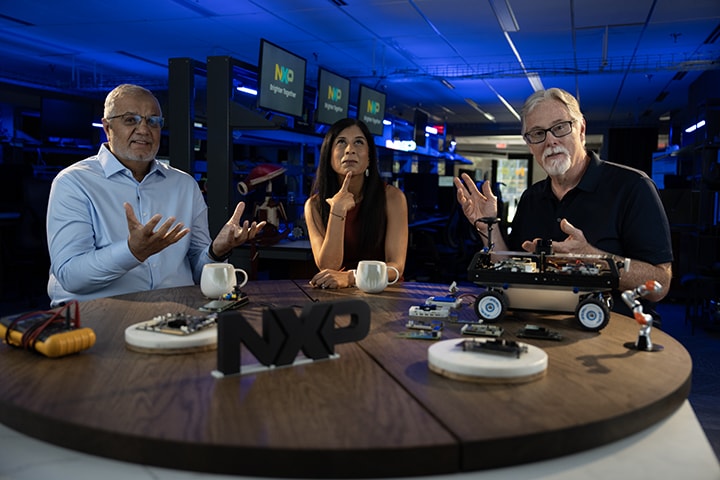 In Conversations at the Edge S2E3, Sujata, Iian and Altaf explore the safety
concerns of AI and mobile robotics.
In Conversations at the Edge S2E3, Sujata, Iian and Altaf explore the safety
concerns of AI and mobile robotics.
Episode 4: Star Wars Got It Right with Distributed Architecture
Yes, we compared today’s mobile robotics to Star Wars. Just look at the movie’s R2-D2, BB-8 or even those mouse
droids scurrying around: each has one job that they do really well. This is the essence of distributed robotics and
this episode.
For developers, the takeaway is to architect platforms that scale across robot types. A humanoid assistant, a
four-wheeled warehouse rover and a quadcopter drone may seem different, but they all need distributed
decision-making. NXP solutions like the i.MX 8M Plus (for vision
and neural acceleration), the S32K1 (for real-time motor control)
and Automotive Ethernet (for lightweight, deterministic
networking) provide those building blocks. The challenge is to assemble them in the right distributed mix.
Watch Now: Conversations at the Edge Season 2, Episode 4
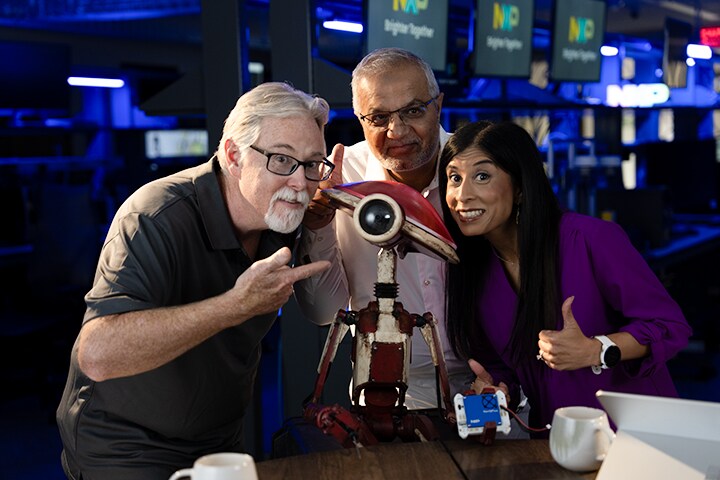 In Conversations at the Edge S2E4, Sujata, Iian and Altaf are joined by a robotic
co-host.
In Conversations at the Edge S2E4, Sujata, Iian and Altaf are joined by a robotic
co-host.
Episode 5: A Centralized Architecture is Dangerous
We opened this episode with a warning: robots are no longer confined or limited to a specific area anymore. They’re
now navigating warehouses, rolling through loading docks and interacting with humans. However, a centralized
architecture simply can’t equip robots with what they need to keep up with unpredictable hazards.
The main takeaway? Safety has to be distributed. That means embedding perception directly into a robot's sensors
(vision, LiDAR and radar) and backing them with supervisory processors that can overrule the main brain if an when
it makes a bad call. Think of it like a reflex: your hand pulls away from a hot stove before your brain can even
process it. For developers, that means working with platforms like NXP’s edge processors this enable this kind of
local intelligence and fail-safe behavior.
Watch Now: Conversations at the Edge Season 2, Episode 5
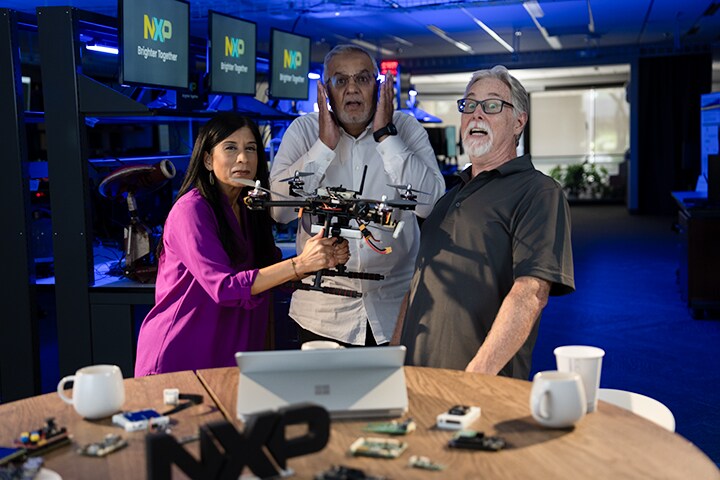 In Conversations at the Edge S2E5, the team outlines why a designing a distributed
architecture is the better bet.
In Conversations at the Edge S2E5, the team outlines why a designing a distributed
architecture is the better bet.
What It Means for Developers
Among these first episodes, one theme stands out: distributed intelligence isn’t a buzzword. It’s a critical
strategy.
The reality is that robots are leaving the lab and entering messy, unpredictable environments. For this reason,
developers need to build with architectures that perceive, decide and act locally, without waiting for a central
brain to figure it out. This requires modular platforms, scalable hardware and robust safety frameworks.
This is exactly what we explore in NXP’s new white paper, From
Stationary Arms to Humanoids: The Journey of Mobile Robotics. It examines control complexity, AI adoption,
and modular robot architectures to offer distributed intelligence as the path forward.
What’s Next in this Season of CATE?
These five episodes are just the first segment of our mobile robotics discussion. Each month, we’ll release a new set
of episodes tackling another facet of robotics. So, if you liked our mix of bold statements and grounded engineering
insights, stay tuned for more (and let us know what you think).
And seriously, don’t just take my word for it. Head over to YouTube to watch the full conversations, see our demos and maybe even
laugh at our analogies (yes, your mom really does belong in this discussion).