Getting Started with FRDM-IMX91S
Contents of this document
-
Out of the Box
-
Get Software
-
Build and Run
-
Developer Experience
Sign in to save your progress. Don't have an account? Create one.
Purchase your FRDM i.MX 91S Development Platform
1. Out of the Box
The following section describes the steps to boot the FRDM-IMX91S.
Development kit contains:
- FRDM-IMX91S board with onboard u-blox module MAYA-W476 with NXP’s Wi-Fi 6 Tri-radio IW610G
- Cable: Assembly, USB 2.0, Type-C male to Type-A male
- TF Card: Linux® BSP image programmed in 32G TF card
- Quick Start Guide
Get started developing your application on the FRDM-IMX91S with the out-of-the-box video. For more information, please visit the i.MX 91 applications processor Documentation.
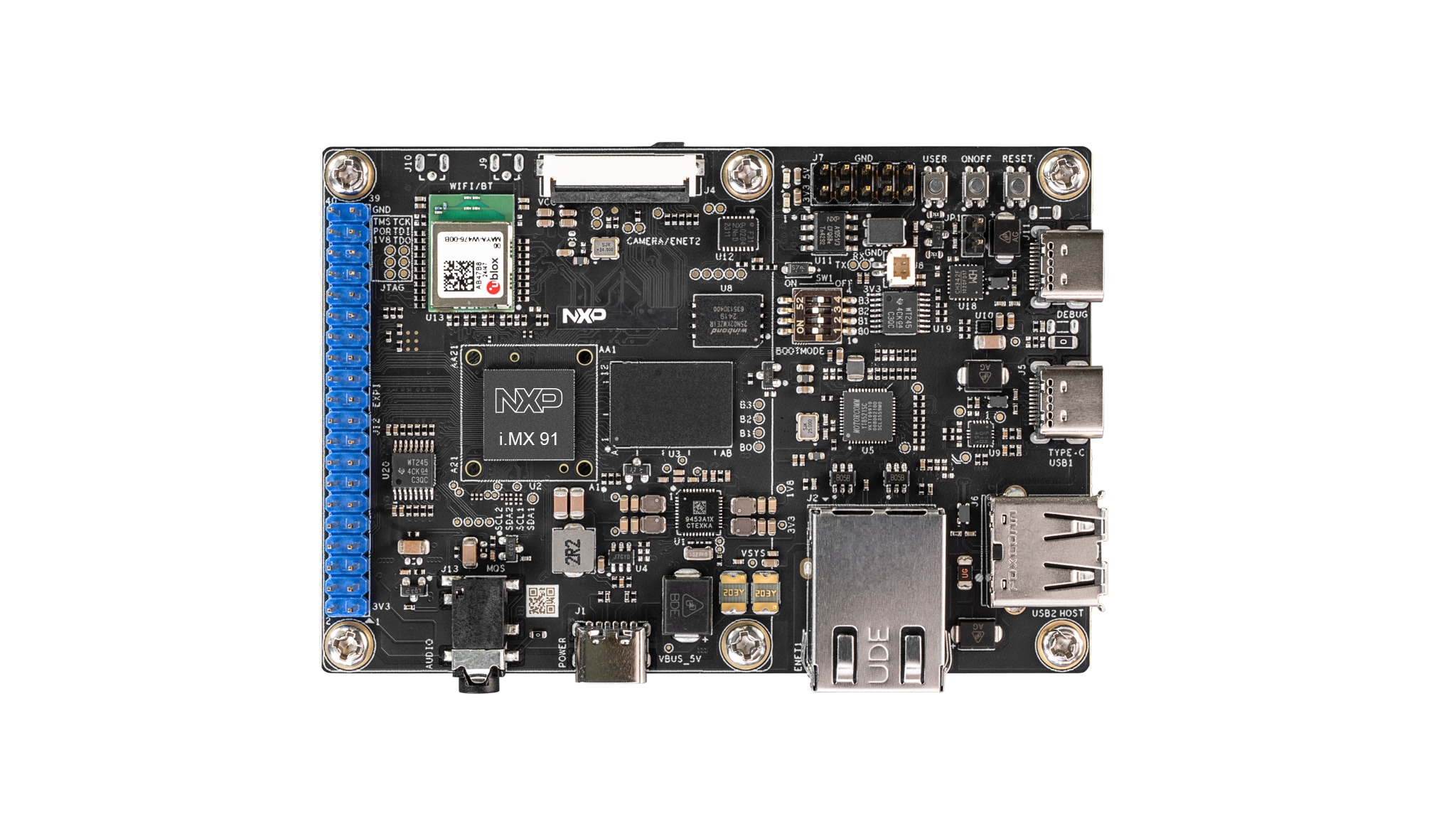
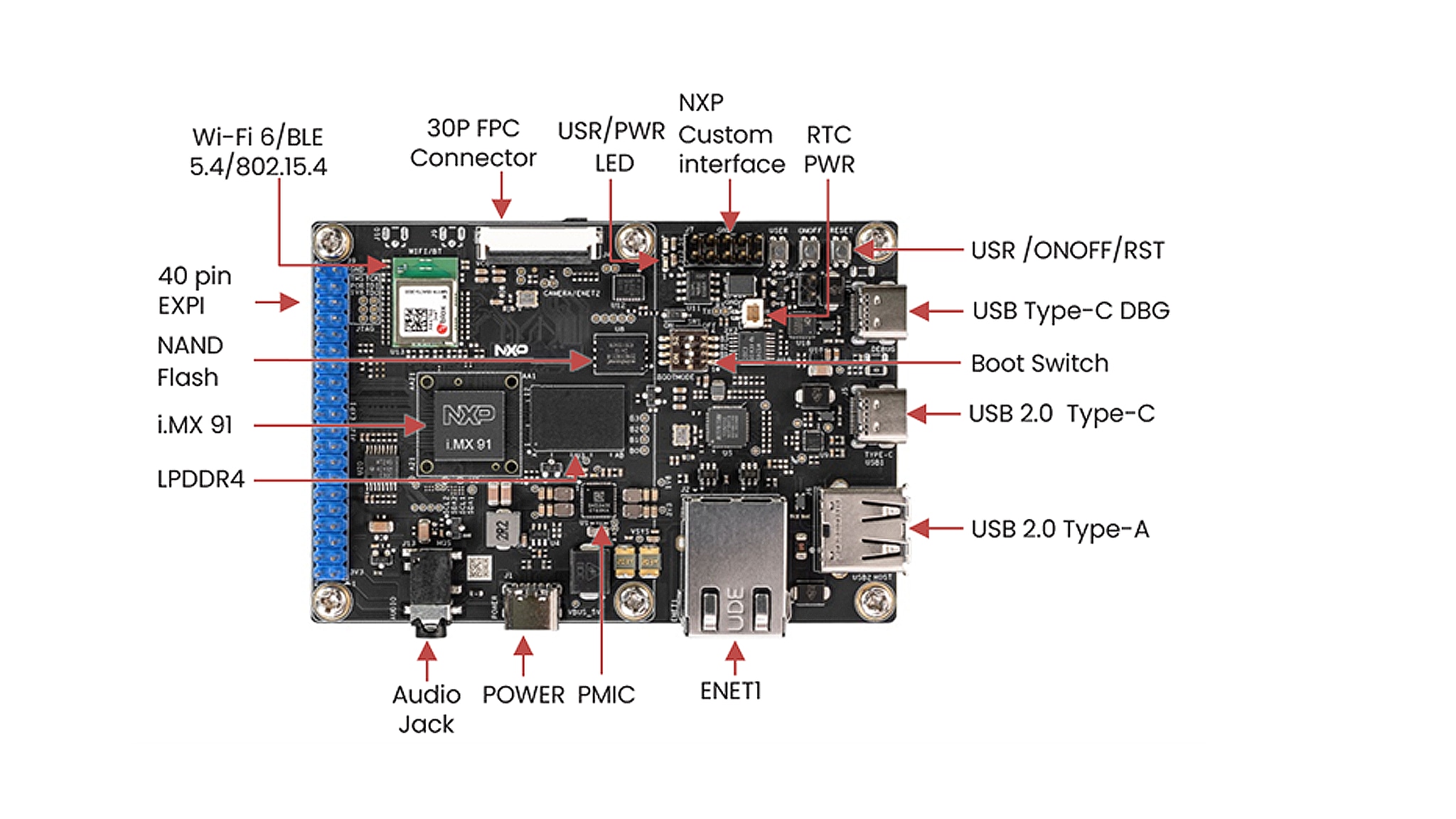
1.1 Get Familiar with the Board
1.2 Boot Option
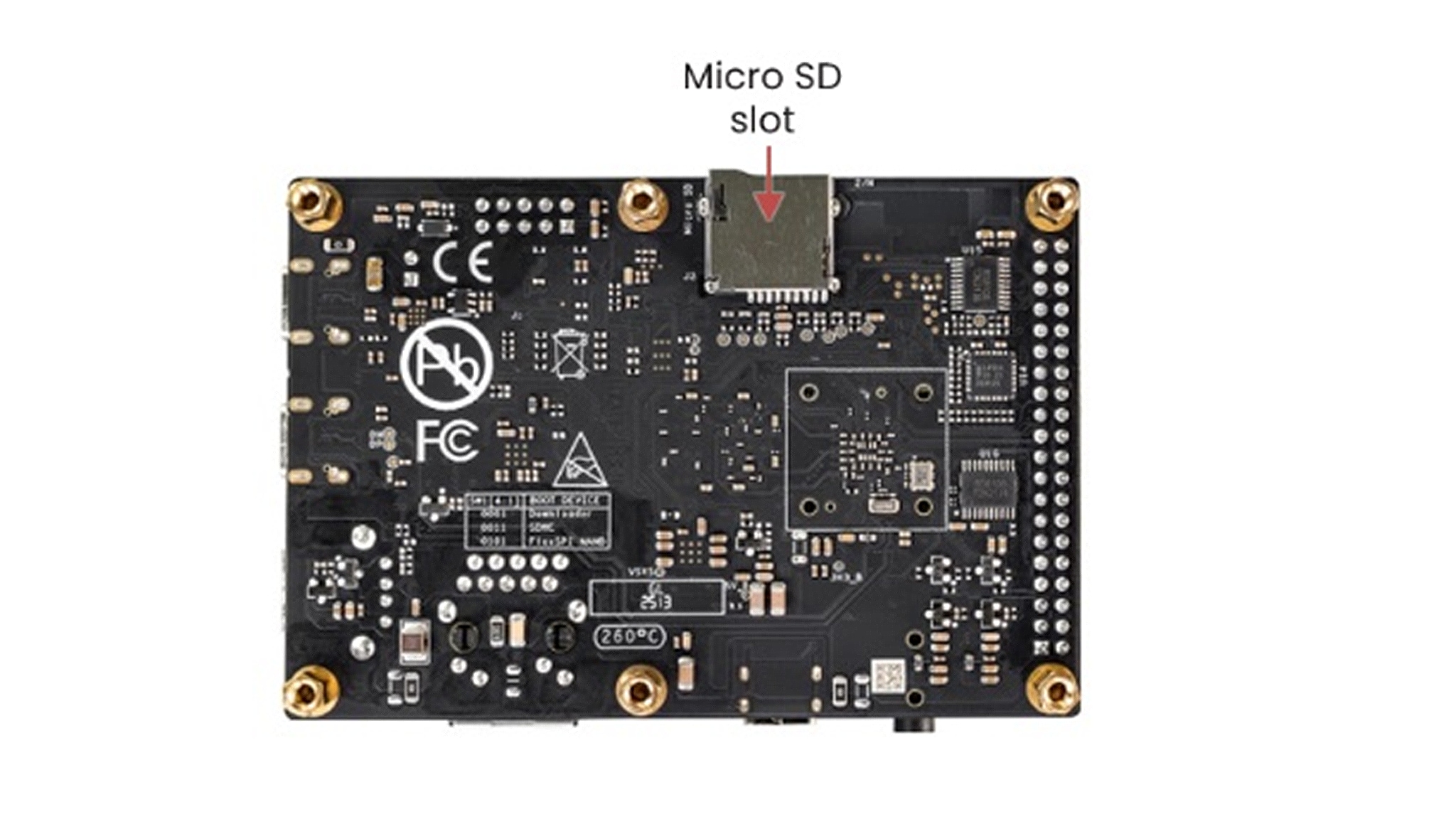
The FRDM-IMX91S comes with a prebuilt NXP Linux binary demo image flashed on the TF card. Without modifying the binary inside, booting from the TF card provides a default system with certain features for building other applications on top of Linux.
FRDM-IMX91S board features integrated 256 MB NAND flash memory supporting direct boot (NAND boot). This includes a deeply trimmed, lightweight file system optimized for reliability and minimal resource consumption. Its small footprint maximizes usable storage while ensuring efficient operation. This file system serves as an ideal starting point – its modular design is fully customizable, allowing you to tailor it further to your specific application needs and optimize performance.
1.3 Connect USB Debug Cable
Connect the supplied USB-Type C cable to the debug UART port J11, then connect the other end of the cable to a host computer.
Two UART connections will appear on the host computer. The first port is for A55 core system debugging.
If you are unfamiliar with terminal applications, please view one of the following tutorials before continuing to step 1.4: Minicom Tutorial, Tera Term Tutorial, PuTTY Tutorial.
To debug under Linux, make sure that CH342F Linux driver is installed.
1.4 Boot Switch Setup
SW1 [4-1] is the boot configuration switch. By default, the boot device is USDHC2 4-bit SD3.0.
| BOOT MODE | SW1-4 |
SW1-3 |
SW1-2 |
SW1-1 |
|---|---|---|---|---|
| Serial Downloader | 0 | 0 | 0 | 1 |
| USDHC2 4-bit SD3.0 | 0 | 0 | 1 | 1 |
| FlexSPI Serial NAND | 0 | 1 | 0 | 1 |
1.5 Board Boot Up
Connect the power supply cable to the power connector (J1), the board will power on automatically.
The serial port starts to print log information to the PC as the board boots up. Congratulations, you are up and running!
2. Get Software
The i.MX Linux board support package (BSP) is a collection of binary files, source code and support files that are used to boot an Embedded Linux image on a specific i.MX development platform.
Current releases of Linux binary demo files can be found on the Linux download page. Additional documentation is available in the i.MX Linux documentation bundle under the Linux sections of the i.MX Software and Development Tools.
2.1 Overview
FRDM-IMX91S support booting from NAND and SD card.
This Getting Started guide only outlines a few methods of flashing the Linux BSP image to an SD card. Experienced Linux developers can explore other options if desired.
2.2 Download NXP Linux BSP Pre-Built Image
The latest prebuilt images for the FRDM-IMX91S are available on the FRDM i.MX 91S Development Board.
The prebuilt NXP Linux binary demo image provides a typical system and basic set of features for using and evaluating the processor. Without modifying the system, the users can evaluate hardware interfaces, test SoC features and run user space applications.
2.3 Burn NXP Linux BSP Image Using Universal Update Utility (UUU)
In addition to the connections from "Out of the Box" section, connect the USB1 (J5) to the host machine using the proper USB cable.
Turn off the board. Refer to the 1.4 Boot Switch Setup section and configure the board to boot in serial download protocol (SDP) mode.
Depending on the OS used in the host machine, the way to transfer the Linux BSP image onto an SD card can vary. Choose an option below for detailed instructions:
Linux®
Install UUU on Linux Distro
Download the latest stable files from UUU GitHub page . If further assistance for UUU is needed, please refer to this extensive tutorial .
uuulibusb1(via apt-get or any other package manager)
Burn the NXP Linux BSP Image to the Board
By default, this procedure flashes the image to the SD card. Check the UUU GitHub page for reference on how to flash the image to other devices.
Open a terminal application and change the directory to the location where uuu and the latest Linux distribution for FRDM-IMX91S are located. Add execution permission to the uuu file and execute it. uuu will wait for the USB device to connect.
$ chmod a+x uuu
$ sudo ./uuu -b sd_all imx-image-full-imx91frdmimx91s.rootfs.wic.zst
Confirm that FRDM-IMX91S boot mode is switched to serial download mode, and turn on the board, uuu will start to flash the images to the SD card.
When it finishes, turn off the board and the terminal. If further assistance with configuring the board to boot from an SD card is needed, please refer to the 1.4 Boot Switch Setup section.
Windows®
Install UUU on Windows Distro
Download the latest stable files from UUU GitHub page . If further assistance for UUU is needed, please refer to this extensive tutorial .
uuu.exe- Serial USB drivers (depending on your board and Windows installation - check Windows Device Manager)
Burn the NXP Linux BSP Image to the Board
By default, this procedure flashes the image to the SD card. Check the UUU GitHub page for reference on how to flash the image to other devices.
Open the command prompt application and navigate to the directory where the uuu.exe file and the Linux release for the FRDM-IMX91S are located.
uuu.exe -b sd_all imx-image-full-imx91frdmimx91s.rootfs.wic.zstConfirm that FRDM-IMX91S boot mode is switched to serial download mode, and turn on the board, uuu will start to copy the images to the board.
When it finishes, turn off the board and the command prompt application. If further assistance with configuring the board to boot from an SD card is needed, please refer to the 1.4 Boot Switch Setup.
3. Build and Run
In this section, a brief guide of how to build Yocto BSP image for FRDM-IMX91S is introduced, along with how to add Matter support and how to build Debian release image.
3.1 FRDM-IMX91S Yocto BSP
The FRDM-IMX91S BSP release is based on i.MX SW 2024 Q3 release with Yocto Project 5.0 (Scarthgap). To build FRDM-IMX91S image from source code, please first check i.MX Yocto Project User’s Guide to get familiar with Yocto project and Yocto build. Then please follow the below steps to build image for FRDM-IMX91S.
- Download i.MX SW 2024 Q3 BSP Release:
- Integrate FRDM-IMX91S layer into Yocto code base:
- Yocto Project Setup:
- Build images:
- Flashing SD card image:
- Change boot switch
SW1[4:1] to “0011” to select SD card boot, insert the SD card and power up the FRDM-IMX91S board
$ repo init -u https://github.com/nxp-imx/imx-manifest -b imx-linux-scarthgap -m imx-6.6.36-2.1.0.xml
$ repo sync$ cd ${MY_YOCTO}/sources
$ git clone https://github.com/nxp-imx-support/meta-imx-frdm.git$ cd ${MY_YOCTO}
$ MACHINE=imx91frdmimx91s DISTRO=fsl-imx-xwayland source sources/meta-imx-frdm/tools/imx-frdm-setup.sh -b frdm-imx91s$ bitbake imx-image-full$ zstdcat imx-image-full-imx91frdmimx91s.rootfs.wic.zst | sudo dd of=/dev/sdx bs=1M && syncOr using uuu to burn image into SD card:
$ uuu -b sd_all imx-image-full-imx91frdmimx91s.rootfs.wic.zst3.2 FRDM-IMX91S Matter Support
FRDM-IMX91S has support for Matter. To include Matter support, please follow below steps to include Matter layer into Yocto build.
- Download i.MX SW 2024 Q3 BSP Release:
- Download i.MX Matter Yocto layer:
- Integrate FRDM-IMX91S layer into Yocto code base:
- Yocto Project Setup:
- Build images:
$ repo init -u https://github.com/nxp-imx/imx-manifest -b imx-linux-scarthgap -m imx-6.6.36-2.1.0.xml
$ repo sync$ cd ${MY_YOCTO}/sources/meta-nxp-connectivity
$ git remote update
$ git checkout imx_matter_2024_q3$ cd ${MY_YOCTO}/sources
$ git clone https://github.com/nxp-imx-support/meta-imx-frdm.git$ cd ${MY_YOCTO}
$ MACHINE=imx91frdmimx91s-iwxxx-matter DISTRO=fsl-imx-xwayland source sources/meta-imx-frdm/tools/imx-frdm-matter-setup.sh bld-xwayland-frdmimx91s$ bitbake imx-image-multimedia3.3 FRDM-IMX91S Debian
FRDM-IMX91S has support for Debian 12 OS. i.MX Debian Linux SDK distribution is a combination of NXP-provided kernel and boot loaders with a Debian distro user-space image, which includes:
- Debian-based rootfs;
- Debian Base (basic packages)
- Debian Server (more packages without GUI Desktop)
- Debian Desktop (with GNOME GUI Desktop)
- Linux kernel
- BSP components
- Various applications (graphics, multimedia, networking, connectivity, security and AI/ML)
For more details of the NXP Debian Linux SDK Distribution, please check the NXP Debian Linux SDK Distribution for i.MX and Layerscape page.
Quick Start with Debian
To create an SD card with Debian for FRDM-IMX91S, please follow below steps.
- Download flex-installer on the Linux host:
- Plug the SD card into the Linux host and install the images as below:
- Plug the SD card into the FRDM-IMX91S board and install the extra packages as below:
- Setup Ethernet network interface by DHCP or setting it manually
- Set correct system time, for example:
- Install extra packages for GNOME GUI Desktop version:
- Or install extra packages for Server version without GUI Desktop:
- After finishing the installation, run the reboot command to boot up the Debian Desktop/Server system
$ wget http://www.nxp.com/lgfiles/sdk/lsdk2412/flex-installer
$ chmod +x flex-installer
$ sudo mv flex-installer /usr/bin# format SD card
$ flex-installer -i pf -d /dev/sdb
# automatically download and install images into SD card
$ flex-installer -i auto -d /dev/mmcblk1 -m imx91frdmimx91s$ dhclient -i end0$ date -s "22 Nov 2024 09:00:00"$ debian-post-install-pkg desktop$ debian-post-install-pkg serverBuilding Debian Images with Flexbuild
To build Debian image with Flexbuild for FRDM-IMX91S, please follow the below steps.
- Set up the build environment:
- Build image with Flexbuild:
- Flexbuild usage: To build individual part of the image, please check below command list for Flexbuild usage:
$ git clone https://github.com/nxp/flexbuild
$ cd flexbuild && ./setup.env
#Continue to run commands below in case you need to build in Docker due to lack of Ubuntu 22.04 or Debian 12 host
$ bld docker
$ source setup.env$ bld -m imx91frdmimx91s$ bld uboot -m imx91frdmimx91s (compile u-boot image for imx91frdmimx91s)
$ bld linux (compile linux kernel for all arm64 i.MX machines)
$ bld bsp -m imx91frdmimx91s (generate BSP firmware)
$ bld boot (generate boot partition tarball including kernel, dtb, modules, distro bootscript for iMX machines)
$ bld multimedia (build multimedia components for i.MX platforms)
$ bld rfs -r debian:server (generate Debian server rootfs)
$ bld apps -r debian:server (compile apps against runtime dependencies of Debian server RootFS)
$ bld merge-apps -r debian:server (merge iMX-specific apps into target Debian server RootFS)
$ bld packrfs -r debian:server (pack and compress target debian server rootfs)4. Developer Experience
To enable faster development for users of all skill levels, NXP provides extensive example applications to showcase various features and capabilities of the platform.
4.1 Application Code Hub
The Application Code Hub (ACH) repository enables engineers to easily find microcontroller and processor software examples, code snippets, application software packs and demos developed by NXP in-house experts. This space provides a quick, easy and consistent way to find microcontroller and processor applications.
ACH provides filter and search options to quickly find specific applications. With the support of Git capabilities, there is an easy way to import and use applications within user’s development environments.
To learn more details of ACH, please visit this link.
4.2 GoPoint for i.MX Applications Processors
The GoPoint for i.MX Application Processors is a user-friendly application launches prebuilt applications packed with the Linux BSP, giving users an excellent out of the box experience and hands on experience with i.MX SoC's capabilities. GoPoint highlights advanced features while providing practical solutions for implementation, with source code and build recipes for the applications provided in GitHub .
To learn more details of GoPoint, please visit this link.
Debug Terminal Setup
Debug Terminal in Linux
Serial Communication Console Setup
The serial-to-USB drivers are available at CH342F Linux Drivers .
On the command prompt of the Linux host machine, run the following command to determine the port number:
$ ls /dev/ttyCH343USB*The first number is for Arm® Cortex®-A53.
Minicom
Use the following commands to install and run the Minicom program:
- Install Minicom using the Ubuntu package manager
- Launch Minicom using a console window using the port number determined earlier
$ sudo apt-get install minicom$ sudo minicom /dev/ttyCH343USB * -s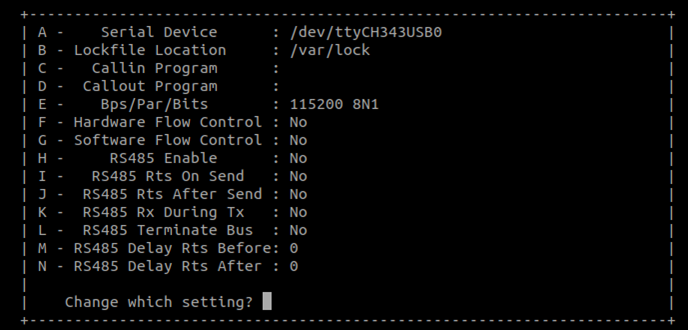
Configure Minicom as shown in Figure and Exit configure.
Debug Terminal in Windows
Serial Communication Console Setup
The WCH USB-serial chip on FRDM-IMX91S enumerates 2 serial ports. Assume that the ports are COM11 and COM12. The first Port(COM11) is for the serial console communication from Arm® Cortex®-A53. The serial-to-USB drivers are available at CH342F Windows Driver .
Tera Term
Tera Term is an open source terminal emulation application. This program displays the information sent from the NXP development platform’s virtual serial port.
- Download Tera Term. After the download, run the installer and then return to this webpage to continue
- Launch Tera Term. The first time it launches, it shows the following dialog. Select the serial option. Assuming your board is plugged in, there should be a COM port automatically populated in the list
- Configure the serial port settings (using the COM port number identified earlier) to 115200 baud rate, 8 data bits, no parity and 1 stop bit. To do this, go to Setup → Serial Port and change the settings
- Verify that the connection is open
PuTTY
PuTTY is a popular terminal emulation application. This program displays the information sent from the NXP development platform’s virtual serial port.
- Download PuTTY. After the download, run the installer and then return to this webpage to continue
- Launch PuTTY by either double-click the executable file you downloaded or from the Start menu, depending on the type of download you selected
- Configure In the window that launches. Select the Serial radio button and enter the COM port number that you determined earlier. Also enter the baud rate, in this case 115200
- Click Open to open the serial connection. Assuming the board is connected, and the correct COM port is entered, the terminal window opens. If the configuration is not correct, PuTTY alerts you
Security and Integrity
Security and Integrity
System security and integrity are always one of the most critical aspects to be considered in product development.
FRDM-IMX91S support secure boot feature and encrypted boot feature, helping to prevent unauthorized software execution during the device boot sequence and protect bootloader data from unauthorized access.
For more details of the secure boot feature, please check application note AN12312 Secure Boot on AHAB Supported Devices.
For more details of the encrypted boot feature, please check application note AN13994 i.MX Encrypted Boot on AHAB-Enabled Devices.
Fast Boot
Fast Boot
In certain use cases, there is a requirement for the device boot time, which means the device needs to complete booting in a given time limit.
To optimize the boot time, FRDM-IMX91S supports falcon mode in U-Boot. Falcon mode is a feature in U-Boot that enables fast booting by allowing SPL to directly start the Linux kernel. It completely skips the U-Boot loading and initialization, with the effect of reducing the time spent in the bootloader.
For how to enable falcon mode and further optimize boot time, please check AN14093 Fast Boot on i.MX 8M and i.MX 9 Using Falcon Mode and Kernel Optimizations.
NAND Boot
NAND Boot
FRDM-IMX91S has a 256MB NAND flash memory on the board. Since the rootfs of a full functionality usually takes over 5GB, the rootfs that can fit into the 256MB NAND storage have to be customized. For how to compile the bootloader and rootfs for NAND boot, and how to download the image into the NAND, please refer to the i.MX FRDM Software User Guide.