Audio Networking
Seamless audio integration of tomorrow’s vehicles demand audio systems that are not only high-performance and scalable, but also fully integrated into the vehicle’s electrical architecture. NXP’s automotive Ethernet solutions provide the essential hardware to build cost-effective, connected and future-ready audio systems.
Due to the special requirements, audio use-cases such as active noise cancellation (ANC), hardware needs to be compliant with all needed standards and must support these. Our audio-ready Ethernet portfolio is tested and provides you with the capabilities needed.
Audio Networking Portfolio
Ethernet Switches
Supporting Ethernet AVB and TSN standards, including comprehensive functionality to ensure reliable, stable and low latency systems for highly integrated audio applications using a shared Ethernet backbone for multi-domain communication.
Ethernet PHYs
Reliable high-speed data communication, IEEE 1000BASE-T1 compliant, single and multi port. NXP PHYs transmit and receive in full duplex over unshielded twisted pair (UTP) cable.
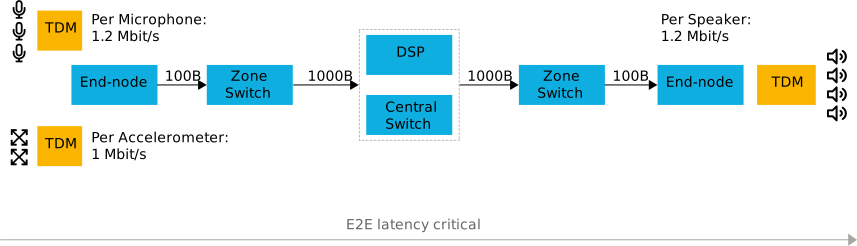
Enabling Future Audio Systems
Modern automotive audio systems are no longer isolated components, they are part of a unified, zonalized electrical architecture, built on the IEEE 802.1 Ethernet standard. This backbone enables high-speed, low-latency, and ultra-reliable communication across all zones of the software-defined vehicle (SDV).
Supporting this, NXP’s Ethernet portfolio delivers excellent audio quality, system safety, and reliability for both infotainment and safety-critical audio functions. Our scalable product lineup includes Switches and PHYs which enable the audio components being fully integrated in a pure Ethernet-based network without relying on proprietary or domain specific components while fulfilling bandwidth, latency and flexibility needs.