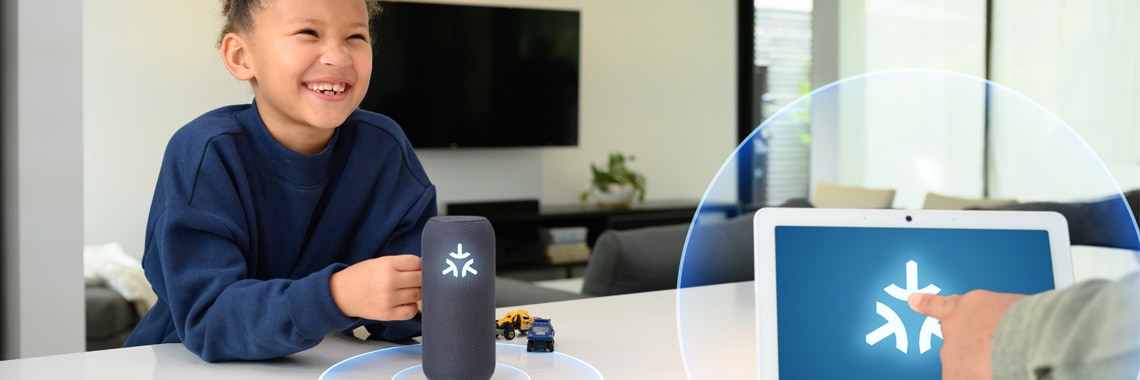
At NXP, we’re known for our longstanding commitment to sustainability. One area where that commitment is front and
center is in
the autonomous smart home. Our
product
portfolio addresses several megatrends—including energy efficiency, device connectivity and AI-driven
automation—that are
helping to reduce carbon footprints and improve living environments on a global scale.
When it comes to saving energy at home, we’re guided by the idea that there are many ways to save power, and small
gains in
efficiency can add up quickly when scaled across a building, a community or a region.
That’s why we offer a wide variety of power-saving solutions, ranging from advanced
applications processors that
support complex,
system-level use cases to individual components, such as AC/DC converters and USB-Type C port solutions, that add
efficiency and
simplify design.
Here’s a look at some of the ways that we’re helping customers meet their energy targets for targets for the
autonomous smart
home and Internet of Things (IoT) devices.
Take a tour of our autonomous smart home showcase from CES 2024 and see how
NXP technology is
driving the future
of smart homes.
Ensuring Your Designs Meet Regulatory Requirements
Many of our autonomous smart home customers offer products in regions where energy-efficiency certificates and/or
government
regulations on energy use are factors to consider when designing home appliances or electronic devices. We help
customers meet
these requirements by offering solutions that include automation for energy monitoring, low-power consumption (when
in active or
sleep modes) and common connectors.
ENERGY STAR Program
In the US, the ENERGY STAR labeling program helps consumers choose energy-efficient products. To earn the ENERGY
STAR label,
products must meet strict energy-efficiency criteria, set by the US Environmental Protection Agency (EPA) or the US
Department
of Energy (DoE). Because ENERGY STAR products use less energy, they help consumers save money on their electricity
bills, and
help protect the environment by causing fewer harmful emissions from power plants. The program currently includes
refrigerators,
TVs, office equipment, light bulbs, water heaters, furnaces and other appliances. The program is expanding to
include Smart Home
Energy Management Systems (SHEMS), which includes devices such as smart thermostats, and smart EV chargers, which
suggest
energy-saving actions based on usage patterns and can automatically control smart-home devices based on room or home
occupancy.
EU Energy-Efficiency Directive
First adopted in 2012, and then updated in 2018 and 2023, directive 2012/27/EU, issued by the European Commission,
calls for EU
member sites to reduce energy consumption by 11.7% by 2030. The idea is that anything that plugs in should use as
little energy
as possible because, by using energy more efficiently, and thereby consuming less, Europeans can lower their energy
bills, help
protect the environment, mitigate climate change, improve the quality of life, reduce the EU’s reliance on external
suppliers of
oil and gas and support the sustainable growth of the EU economy. The directive indirectly increases the need for
solutions that
can monitor and optimize energy consumption in real time, leading to reduced wastage and lower carbon emissions.
USB-Type C Ports
Another EU directive, 2022/2380, amends the Radio Equipment Device Directive 2014/53/EU, to require a “common
charging”
solution—in the form of a USB-Type C connector—for connected electronic devices, including smartphones and laptops.
Standardizing on the USB-Type C charging interface lets consumers charge their devices with any USB-C charger,
regardless of the
device brand, and lets consumers share chargers and cables between multiple devices. This also improves the consumer
experience,
by eliminating the junk drawer or bin full of miscellaneous chargers and cables used by different devices. It also
helps stem
environmental pollution by limiting the number of chargers retired when new devices are purchased. The directive
specifies that
all smartphones must use the Type-C connector by December 2024, and all laptops must do so by April 2026.
While the EU directive for USB-Type C connectors is only enforceable within the European Union, other regions are
following
suit. India, for example, has issued a similar requirement for all electronic devices to use Type-C as the standard
charging
port by March 2025. Similarly, in 2023, California became the first US state to mandate that all electronic devices,
including
laptops and phones, be charged with the same USB-Type C cable by 2026.
Groundbreaking Use Cases
At the same time that we’re helping customers meet regulatory requirements and government-specified energy targets,
we’re also
helping them support new use cases that leverage the intersection of energy efficiency, autonomy and sustainability.
Bidirectional Charging
Most batteries in today’s electric vehicles (EVs) support what’s called unidirectional charging, meaning the energy
flows in
only one direction–from the power source to the battery. With bidirectional charging, energy travels from the
charger to the
battery or from the battery to the charger. The vehicle becomes both a consumer and provider of energy. The EV can
do things
like send energy back to the grid, making it easier for utilities to manage the local power grid, or power the house
when
electricity rates are high or when there’s a blackout. Managing how the vehicle takes or returns energy requires
smart-charging
technology, to ensure the process of bidirectional conversion runs smoothly. As a leading partner of automotive OEMs
and Tier 1
system suppliers, we already offer a range of solutions for EV charging, and have the technologies needed to create
flexible,
efficient bidirectional charging solutions.
Always-On Appliances
Electronic devices may continue to use power even when they are in the off, standby or sleep modes, and this
“always-on”
consumption can add up. Devices like TVs, which have a remote and wait to receive the signal and respond to it, fall
into this
category, as do devices like microwaves, which have a digital display such as a clock or an LED status light. Our
high-efficiency AC/DC
converters, and
other components that minimize power consumption while devices are idle, can help reduce the impact of always-on
appliances.
Listening Devices
A variation of the “always on” device is the “listening device,” which waits for an audio command that turns on
operation. Smart
speakers, streaming devices and other devices that respond to voice commands can consume several watts of power when
in
listening mode. Multiply that across millions of homes, and the extra electricity adds up. Adding to the power
consumption is
the fact that many of these devices do most of their voice processing in the cloud, in energy-intensive data
centers. Edge
computing, which uses application processors and other components to sense the environment, understand commands and
act on
inputs, without costly transfers to the cloud, helps reduce the energy footprint of listening devices.
AC/DC Conversion
Power outlets tend to provide AC power, while electronic devices (and their batteries) tend to use DC power. As a
result,
converting AC to DC power is a fact of life for devices that connect to a wall outlet and batteries that are charged
with a wall
plug. Each time a conversion takes place, though, a little bit of energy is lost. Our AC/DC solutions are optimized
for
efficiency, and meet or exceed all applicable US DoE and EU Certificate of Conformity (CoC) standards for energy
conservation.
Specific Product Families
We’ve already mentioned some of the autonomous home solutions that we offer that make energy go farther, either by
adding
automation, increasing efficiency or reducing waste. Here’s a closer look at the details.
i.MX 8 and i.MX 9 Applications Processors
Our i.MX applications
processors are part
of a performance-scalable multicore platform that includes single-, dual- and quad-core families based on the
Arm®
Cortex® architecture. They support advanced graphics, imaging, machine vision, audio, voice, video
and
safety-critical applications—and use our innovative Energy Flex architecture to optimize energy and help reduce
carbon
footprint.
In the autonomous home segment, i.MX processors support the development of energy-efficient appliances, security
systems and
home-control systems. They’re enabling true automation, with features that can sense the environment and learn from
or react to
our actions, and are enabling more immersive experiences with features like high-end audio with low-power operation.
The Energy
Flex architecture combines heterogeneous domain processing with fine-grained power management to minimize energy
usage for each
application mode. Separate domains govern different operations, such as application processing, real-time functions
or
high-speed I/O, and each domain can be powered on or off at the required performance point, so energy consumption is
kept to a
minimum. For example, low-power audio use cases can be powered by the real-time domain, where audio can run while
the rest of
the processor is switched off.
For the autonomous home, the i.MX 8 series includes the
i.MX 8M Mini and
i.MX 8M Nano processors, for
multiple audio
interfaces and processing capabilities at low power. The series also includes the
i.MX 8M Plus, for display,
connectivity and
an optimized ratio of processing power to energy, and the
i.MX 8ULP processor, an
ultra-low-power device
with low standby power, fast wake time and support for an energy-efficient, always-on display. The i.MX 8ULP
processor is
perfect for battery powered devices like smart panels, remote light dimmers and Bluetooth-powered speakers. Our i.MX
9 series
applications processors balance low-power operation with the processing, vision, display and connectivity needs. The
i.MX 93 and i.MX 8M Plus have vision-enabled use cases that involve cameras, display interfaces and video
surveillance and gesture detection. i.MX 8M Plus can also support this even in lesser light conditions.
PCA945x and PCA946x PMICs
Optimized for use with i.MX 8 and i.MX 9 application processors, these single-chip power-management ICs (PMICs)
ensure maximum
efficiency in IoT and Autonomous Home devices. The
PCA9450 PMIC family pairs
with the
i.MX 8M Mini, i.MX 8M Nano and i.MX 8M Plus applications processors, while the
PCA9460 PMIC family pairs
with the
i.MX 8ULP processor. The PCA9460 also
supports special modes to support a combined lowest deep sleep power of the system (<0.2mW). This enables energy
star rating and sustainability goals for a green building or green home.The PCA9451A pairs with the
i.MX 91 or
i.MX 93 applications processors.
With so many options, covering different i.MX applications processors and PCA94xx PMICs, developers can select the
combination
best suited for their needs. They can, for example, optimize for cost in autonomous home applications, or optimize
for quiescent
current (IQ), which is the current flowing into a system in standby mode with a light or no load, in IoT
applications.
TEA2xxx Series AC/DC Converters
Our innovative GreenChip power
portfolio enables
smarter, more compact and extremely energy-efficient power solutions. From energy-saving power supplies to fast
battery chargers
and adapters, system protectors and secure wireless chargers, the TEA2xxx series of AC/DC converters addresses a
wide range of
applications, including laptops, gaming devices, TVs and more. The TEA2016/2017 is for resonant power with power
factor
correction (PFC) in laptops and gaming applications. The TEA2376, for flat-screen TVs, interleaves PFC with high
efficiency
across load/range conditions, including low-load conditions to match energy-saving criteria and the TEA2220x is an
active-bridge
solution that simplifies and increases the overall efficiency of AC to DC conversion.
USB-Type C Port Solutions
To support the transition to USB-Type C ports as universal chargers, we offer a number of optimized solutions that
increase
efficiency while saving development time. The
NX20P5090 is a 20V, overvoltage
protection load
switch (sink) with IEC surge protection up to 90V or 100V, the
NX5P3363 is a 5V load switch with
overcurrent
protection (source) and IEC surge protection to +80V, and the
NX20P3483 is a bidirectional
sink/source
combination load switch with protection. The
NX20P0407 is a 28V dataline
protector for CC and
SBU signals, and the NX20PO477 is a 28V dataline protector with moisture detection and corrosion protection.
Wireless Connectivity
As the recommended WiFi attachment for the i.MX 8ULP processor, the
IW416
is a highly integrated Wi-Fi 4 and Bluetooth 5.2 System-on-Chip (SoC) enabling a low-cost connectivity solution. In
addition to
classic Bluetooth features, the IW416 enables Bluetooth 5.2 capabilities, including Low Energy (LE), LE long range,
LE 2 Mbps
and Periodic Advertising Sync Transfer (PAST).
Take the Next Step
NXP solutions for the sustainable autonomous home include the right blend of processors, connectivity, power
management and other
components to help you realize your next energy-efficient design.
Our energy-efficient, low-power applications processors and system-optimized solutions help customers meet their
design needs
and energy targets. We’re helping customers achieve energy-efficiency certification and meet government regulations,
including
Energy Star, the EU Energy Directive and the USB-Type C mandates. We’re enabling sustainability by offering
energy-efficient
solutions for autonomous home, including bidirectional energy transfer, and our Energy Flex architecture helps i.MX
processors
deliver more engaging home experiences while conserving power.