- Smarter World Blog
- NXP Cloud-Connected BMS Powers Secure Twinning for EU Battery Passport Compliance
NXP Cloud-Connected BMS Powers Secure Twinning for EU Battery Passport Compliance

The EU BP (battery passport) is effective 2027 and drives secure, sustainable battery use. NXP and TNO’s SecureBMS meets these needs with advanced hardware, secure data sharing and cloud integration. The features of SecureBMS ensure traceability, safety and compliance for next-gen energy systems.
Mandated by the European Commission, the requirement takes effect in February 2027 and applies to the following categories:
- Light means of transport batteries (e.g. bikes, scooters)
- Industrial batteries over 2 kWh
- Electric vehicle (EV) batteries
A key component of the legislation is the Battery Management System (BMS), which provides the current values of the recorded parameters of the battery.
A Secure Element is a tamper-resistant hardware component designed to securely store sensitive data and execute cryptographic operations. Therein a Secure Element is added that collects and tracks detailed performance data, including charge cycles, state of health and temperature history. But the Battery Passport introduces a new requirement secure data sharing. This means that current BMS solutions either lack proper security features or have ones that don’t meet legal standards.
Strengthening BMS Security for Battery Passport Compliance
Two security issues stand out when it comes to security: unauthorized changes to data and replacing uncertified batteries. Robust authentication and verification processes are needed to mitigate both of these risks.
Addressing these challenges, NXP Semiconductors and TNO have introduced a Battery-Passport demonstrator, featuring secure data transmission and effective user access rights management. This project is based on a BMS hardware reference design and is intended for use in battery energy storage systems (BESS).
TNO is using the hardware together with the flexible open source Battery Management System (foxBMS) open-source software and some modules from a recovered BESS, to form a testbed-placed system that will feed live data from the battery module to the cloud database. Effective software test cases for unauthorized changes to data are being tested against the secured channel between the BMS and the cloud. While the certification of the modules is done via hardware-integrated security features.
Enable Battery Passport Compliance with NXP and TNO SecureBMS. Meet EU Battery Passport requirements with integrated Secure Elements, cryptographic data handling and ASIL D safety by leveraging NXP cloud-connected BMS architecture.
Architecture and Features of the NXP BESS-BMS
The NXP BESS-BMS, forming the base for the SecureBMS system approach, includes three key components:
- Battery Management Unit (BMU)
- Cell Management Unit (CMU)
- Battery Junction Box (BJB)
The BMU in this system incorporates an NXP S32K358 microcontroller, equipped with three Arm® Cortex®-M7 based cores, two of which operate as a lockstep core. This design allows the BMS software to achieve ASIL D safety standards by running directly on a single core, eliminating the need to compare two separate threads on two distinct cores.
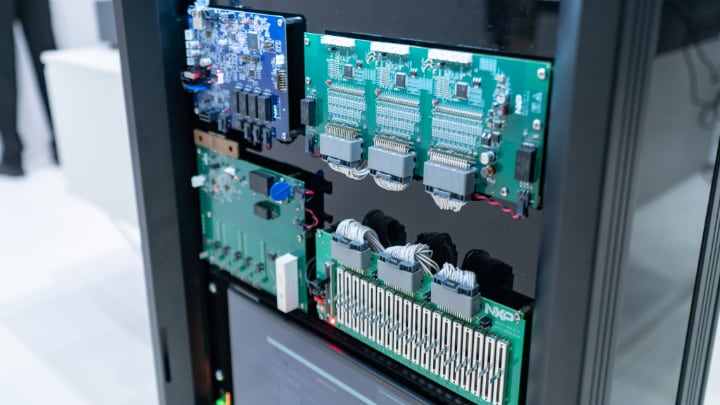
Complementing the microcontroller on the same BMU PCB is the NXP NCJ37-BMS Secure Element, which interfaces with the microcontroller unit (MCU) via an Inter-Integrated Circuit (I2C) connection. The NCJ37-BMS Secure Element is automotive Automotive Electronics Council (AEC)-Q100 and Common Criteria Evaluation Assurance Level (EAL6+) certified—an industry standard for high secure applications. For example, the BMS Secure Element used for payment cards or travel passports. The NCJ37-BMS comes with a dedicated SecureBMS JavaCard applet which is capable of securely storing and managing battery passport-specific data formats through authentication.
Furthermore, the Secure Element can communicate with external devices via a passive, powered-by-the-field Near Field Communication (NFC) interface, even when the BMS system is powered down or disconnected from the 12 V power supply. This enables users to securely read out battery-related information using an NFC-enabled smartphone or other devices according to the digital product passport standard. This advanced architecture highlights the BMU's robust safety and security capabilities, making it well-suited for demanding applications.
The BMS software enables cell voltage and current measurements with full functional safety to complement the hardware. It includes interface software for communicating with the Secure Element and storing data processed by State-of-Charge (SoC) or State-of-Health (SoH) algorithms in its memory. The package also features a host library for Secure Element communication and a cryptolibrary to encrypt data sent to the cloud. This streamlined software enhances data integrity, security and integration with external systems.
In larger, multiple-battery systems, Secure Elements can also ensure secure cloud endpoints. Adding one within the battery allows independent storage of the legally required local copy of the battery passport—even during logistics, servicing, remanufacturing or recycling. A cloud connection is established via a gateway based on the NXP GoldBox reference design, which provides direct access to Amazon Web Services (AWS) or other cloud platforms.
Driving Smarter Energy Management Through Secure Innovation
The move toward secure, cloud-connected BMS solutions marks a major advance in battery sustainability. By tackling challenges like security and life-cycle tracking, systems (such as NXP’s BESS-BMS) support the EU Battery Passport’s goals—ensuring batteries are not only efficient but also transparent and accountable. Through cutting-edge technology and strong partnerships, NXP is helping shape a smarter, safer and more sustainable energy future.
Authors

Marc Manninger
Marc Manninger is a product and marketing manager with 10 years of experience in the semiconductor industry. He holds a Master’s Degree in software engineering and business management from Graz University of Technology and Sao Paulo. Throughout his professional career, he has worked on various software projects and products for smart car access. As a product and marketing manager, he is currently responsible for NXP’s automotive UWB, NFC and secure elements.

Wenzel Prochazka
With over 15 years of experience in electric vehicle (EV) battery and powertrain development, Wenzel joined NXP in 2023 to lead the development of electrification system products. Today, he helps develop automotive systems and build stronger connections with customers with the help of innovative processing and analog system solutions.
He believes that sustainability, affordability, and clear communication are the key ingredients for making progress in the EV world—making the journey toward an electric future more collaborative and rewarding for everyone involved.