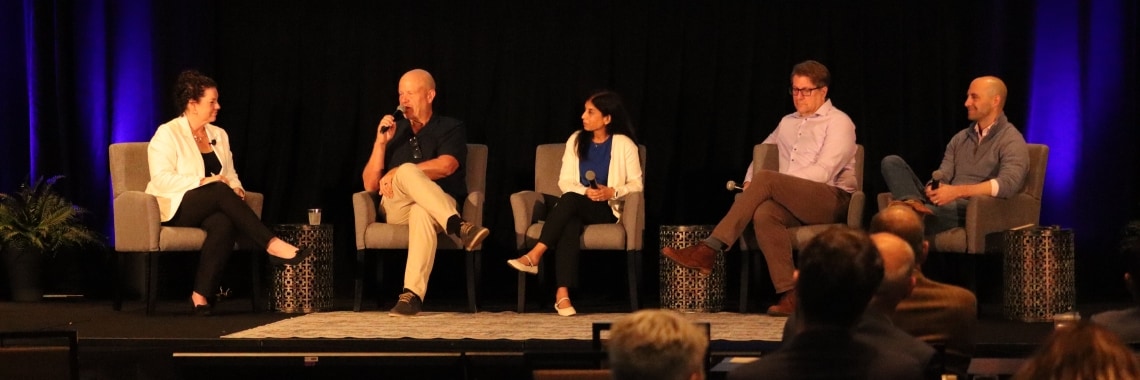
At the recent Parks Associates’ CONNECTIONS™ Connected Home Conference themed as “Highlighting Innovation,” our Sujata Neidig of NXP participated in a workshop panel on “Solving the User Experience.” Sujata is excited to share key takeaways from this valuable event.
Parks Associates shares incredibly helpful insights and perspectives gained through its research which frames the smart home market—its history, current state, future outlook, and the key trends driving today’s innovation. This view is further expanded at the CONNECTIONS™ Connected Home Conference through various panel discussions bringing in perspectives from a variety of people and solution companies including NXP, device makers, service providers, standards organizations, ecosystems and more.
NXP is a solutions provider for the smart home market. Check out NXP’s consumer solutions designed to elevate the home experience.
At this year's conference, some key trends that stood out and resonated with me include:
This year, several key trends that stood out and resonated with me. First was how smart home is growing rapidly and how the use of technology among home owners/residents has progressed from early adopters to an early majority.
For the smart home market, intelligent living is the value proposition, which means that smart devices and smart homes must evolve by attaching the services needed to deliver the intelligence.
User experience is defined by the total life cycle from the set-up process and the usage of device/system/service once installed and well into the future. As for set-up, it is not just about do-it-yourself—it also involves professional installers (or, do-it-for-me). For ‘”how to use,” the next wave of user interface (UI) needs to be as seamless as possible (e.g., routines, automations), as smart home users want seamless experiences.
Continued focus on interoperability as a foundational element to address the needs of the users. Interoperability opens new ways for businesses to deliver valued experiences: partnerships for complementary products, ability to invest in and focus on innovation (e.g., AI), larger serviceable market, and creating opportunities for new business models, such as services.
AI is everywhere—or at least, AI is being talked about everywhere. AI gives context, provides an invisible, “behind-the-scenes” way to deliver value to smart home users, and creates efficiencies. But, companies also have to consider ways to monetize AI and address user/consumer skepticism. Standout applications for the smart home this year are video security devices, access control, thermostats and smart lights.
Panel Discussion on Interoperability: Key Takeaways
In the Business of Smart Home workshop, I had the opportunity to participate on a panel alongside astute leaders from Tractive, Cardinal Peak and Anker, moderated by Elizabeth Parks. Solving the User Experience. The main areas we delved into were:
- Reducing friction and seamless onboarding in setup and use
- UX in a maturing market
- Evolving experiences with AI and feedback loops
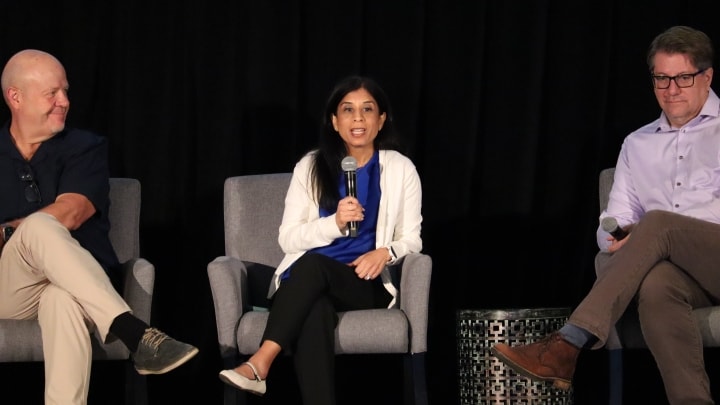 Caption: Sujata Neidig speaking at the Solving the User Experience panel.
Our panel had a very interesting conversation around interoperability, user experiences, services and AI—all themes that had just been addressed by Jennifer Kent in her research presentation! Our conversation on these themes highlighted that at this stage of the market, companies must re-evaluate and revamp their product strategies and business models to address the needs of end users. By doing this, the opportunities for innovation and market success are vast. As we discussed the market requirements and advancements in technologies, we also noted that there is now more focus on deployments than on new technology explorations, which underlines that the smart home market truly is maturing.
NXP empowers smart home innovation by delivering integrated silicon, software and systems that accelerate product development. We are seeing strong growth across both established and emerging categories, from automation and entertainment to next-generation appliances. Our end-to-end support spans use case definition, platform development, standards alignment and deployment readiness. We invest in key technologies and protocols—including Matter, Thread, Wi-Fi, Bluetooth, NFC, UWB and AI—to help partners deliver seamless, future-ready user experiences.