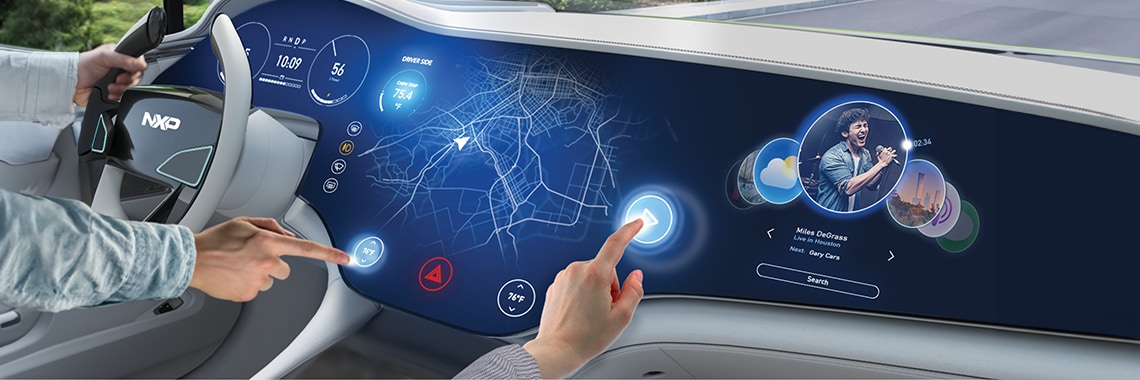
Rapid advances in microelectronics and software technologies are transforming
automotive infotainment
and safety system design in profound ways that are redefining the driving experience.
At the center of this transformation is the electronic cockpit, or eCockpit, a sophisticated system within modern vehicles that
integrates infotainment, connectivity and safety monitoring functions into a single, cohesive interface. An eCockpit
controls
everything that keeps drivers informed and connected, enhancing vehicle safety through real-time monitoring and
autonomous
response.
The heart of an eCockpit is the cockpit domain controller, which consolidates multiple electronic control units
(ECUs) into one
unified system that seamlessly manages connectivity, displays and touchscreens,
digital instrument clusters, infotainment and driver assistance features.
Enter
NXP’s i.MX 95 applications processor family. This high-performance system-on-chip (SoC)
platform provides a highly integrated domain controller solution for today’s
eCockpit designs. Its heterogeneous multicore architecture can control both the head unit and digital cluster, as
well as a
heads-up display, with remarkable efficiency and sophistication. This consolidation simplifies the eCockpit
architecture,
reduces the cost of cables and connectors and eases design complexity.
Three Automotive Trends Driving eCockpit Design
The evolution of automotive cockpits into advanced eCockpits reflects a shift from mechanical controls to digital
displays that
enhance driver experience with customization, wireless communication, internet access and smartphone integration.
Three key
trends are reshaping eCockpit design:
-
Vehicle
Electrification: As electric vehicles (EVs) become more affordable due to reduced supply chain issues
and competitive
pricing, cost-effective eCockpit designs are essential for accelerating the shift from internal combustion
engines to electric
power.
-
Software-Defined Vehicles (SDV): Cars are evolving into software-upgradable networks
that support rapid feature updates and enhancements through
over-the-air (OTA) technology, moving away from fixed hardware designs.
-
Advanced Safety Systems: Modern vehicles are equipped with
advanced driver assistance systems (ADAS)
such as lane departure and adaptive cruise control along with
driver monitoring systems (DMS). eCockpit designs must meet the latest safety
standards to ensure functional safety.
eCockpits are redefining the driving experience. Discover how to elevate eCockpit design while
reducing
costs with NXP’s
i.MX 95 applications processor.
Choosing the Right Cockpit Domain Controller Solution
As the auto industry shifts toward a future defined by affordable EVs, SDV technology and advanced safety systems,
the need for
cost-optimized eCockpit solutions is more critical than ever. The i.MX 95 applications processor addresses this
market with an
integrated multicore architecture, including up to six Arm® Cortex-A55 cores, along with graphics, machine vision
and video
acceleration, providing excellent scalability of computing power for eCockpit designs. The processor’s independent
safety domain
features an Arm® Cortex-M7 processor, which provides a safe processing context for applications required to meet the
ISO 26262
ASIL-B safety standard while eliminating the need for a companion MCU. Combining low-power, real-time and
high-performance
processing in a single, flexible SoC, the i.MX 95 processor provides a powerful, scalable platform with all the
essential
technologies developers need to simplify eCockpit designs. This integrated approach reduces system cost and
simplifies OTA
software updates while minimizing weight and power consumption, which are increasingly important design factors for
EVs.
 NXP’s i.MX 95 applications processor
A Highly Integrated Alternative to Hypervisor Software
A hypervisor is a layer of software that runs at the lowest level of an SoC to support guest operating systems. In
typical
eCockpit designs, a hypervisor enables multiple operating systems, such as Android OS for the head unit and Linux
RTOS for the
instrument cluster, to run simultaneously on a single processor. Traditional hypervisor-based systems require this
extra
software layer to manage multiple operating systems, adding cost and complexity to the design and potential
performance
bottlenecks.
In contrast, the i.MX 95 processor’s heterogeneous multicore architecture eliminates the need for hypervisor
technology. It can
run safety-related functions such as the cluster display and audio chimes on a safe RTOS running on the Cortex-M7
core, while
the Cortex-A55 cores are dedicated to running non-critical tasks on a rich OS such as Android. By allowing different
cores to
run separate operating systems directly, developers can avoid the performance impact and additional cost and
complexity of
implementing a hypervisor. The processor’s Cortex-M7 core can also perform safety monitoring for other critical
tasks such as
the DMS. At the same time, other cores can run Android OS, providing a rich, driver-friendly interface for
infotainment systems,
without interfering with safety-critical functions.
State-of-the-Art Machine Vision and Graphics Processing
Machine vision has become a must-have feature for eCockpit systems, as features such as DMS, surround view and
traffic sign
recognition (TSR) become prevalent. The i.MX 95 processor’s
eIQ Neutron
neural
processing unit (NPU) can drive machine vision as part of a unified vision processing pipeline comprising multiple
camera
sensors or network-attached smart cameras. The embedded NXP image signal processor (ISP) supports a wide range of
imaging
sensors, including infrared-capable devices, for machine vision applications.
The i.MX 95 processor’s graphics processing and multimedia capabilities are particularly useful for immersive
eCockpit
experiences. An integrated Arm Mali GPU enables developers to deliver rich, vibrant 3D graphics, scaling from
eCockpit digital
clusters to multi-display infotainment systems.
Functionally Safe by Design
When it comes to
functional
safety,
the i.MX 95 processor covers all the bases by enabling ISO 26262 ASIL-B compliant automotive designs with its
functional safety
domain. The processor can support a wide array of safety-critical functions such as audible alerts, instrumentation
lights and
camera displays to meet the high-reliability standards set by automotive OEMs.
Future-Proof Your Next eCockpit Design
As the automotive industry continues to evolve and innovate, the
i.MX 95
family stands
out as a powerful, highly integrated processing solution that can reduce the cost and complexity of eCockpit
designs. As a
one-stop supplier of automotive silicon and software solutions, NXP also offers a comprehensive portfolio of
power management ICs (PMICs), tuners,
Wi-Fi and Bluetooth wireless SoCs, CAN/Ethernet
transceivers,
SDV platforms
and
HMI design tools to
streamline the
development of feature-rich automotive infotainment systems.
Explore how
NXP’s
i.MX 95 processor
can enhance your eCockpit experience, ensuring cost-effective implementation through a streamlined architecture. For
more
information on the i.MX 95 processor family and other NXP automotive products, contact NXP Sales
worldwide.