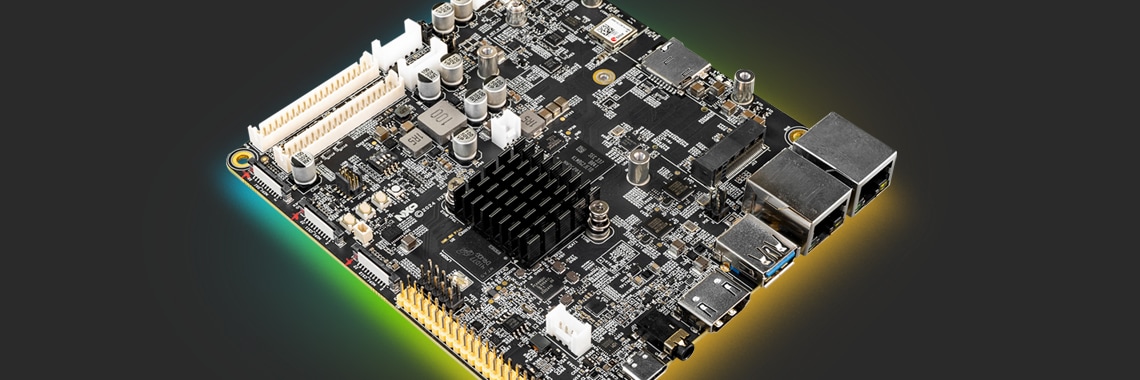
Developers working on advanced HMI applications, computer vision systems and edge AI projects often face a common—gaining access to sufficient processing power without relying on expensive and complex development platforms. Enter the FRDM i.MX 8M Plus solution—a platform designed with developers in mind.
Development platforms are often inaccessible and too costly for development teams, which creates a gap between capability requirements and available development tools. NXP’s FRDM i.MX 8M Plus platform offers cost-effective access to capabilities that were previously limited to expensive evaluation platforms, expanding accessibility to a broader range of development teams.
Processing and Connectivity Needs Are Changing
Embedded applications require multidomain computing capabilities that perform well beyond single-core architectures. For example, a smart factory controller must simultaneously manage real-time machinery control, run Linux® applications for user interfaces and networking and perform AI inference for quality inspection or predictive maintenance.
Another notable trend in embedded system architecture is the shift from simple microcontroller applications to edge computing. Applications that once focused on basic sensor readings and data transmission now use machine learning (ML) algorithms and real-time image processing for intelligent decision-making.
To keep up with the latest requirements, embedded systems need to support multiple wireless standards—including Wi-Fi 6 for high-bandwidth applications, BLE for shorter-range device communication and low-power protocols like 802.15.4 for IoT sensor networks. Managing multiple wireless standards often forces designers to use separate controllers. This raises issues with power management and coexistence interference.
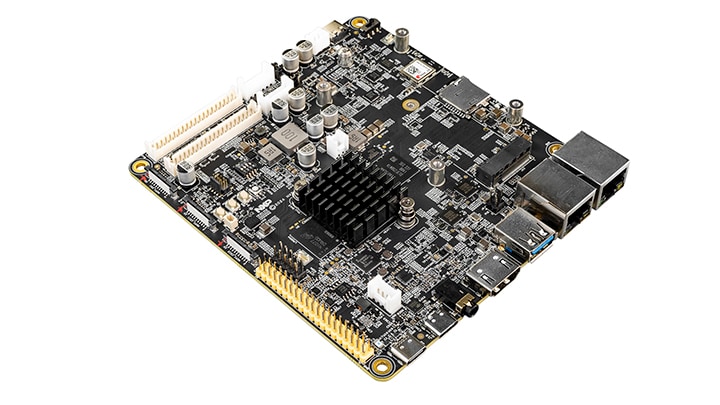 The FRDM i.MX 8M Plus Development Board.
Edge and Cloud Inference Requirements
The FRDM i.MX 8M Plus board handles both edge and cloud-based inference. Edge inference maintains sensitive data on the device, responds immediately to time-critical events and works without constant network connectivity. The platform’s 2 tera operations per second (TOPS) neural processing unit (NPU) can handle edge inference object detection, facial recognition and predictive maintenance algorithms.
Cost and Development Time Constraints
With tighter project timelines and rising stakeholder expectations, development teams face mounting pressure to deliver working prototypes more rapidly than ever before. Instead of basic proof-of-concept builds, stakeholders now expect a complete hardware-software integration from day one. These expectations leave little time for platform setup and configuration, which are tasks that would previously take weeks during early development.
FRDM i.MX 8M Plus boards offer cost advantages—compared to full evaluation kit (EVK) solutions—maintaining core capabilities necessary for application development. Preloaded to each board, GoPoint for i.MX applications processors eliminate weeks of basic setup by providing immediate access to working implementations. These implementations showcase platform capabilities and serve as starting points for custom development.
Your existing expansion boards will also continue to work, protecting investments in sensors, displays and other accessories previously purchased.
A Closer Look at the FRDM i.MX 8M Plus
The FRDM i.MX 8M Plus is built around its applications processor, which features a heterogeneous computing design for handling processing needs efficiently. The processor uses four Arm® Cortex®-A53 cores for Linux applications and a dedicated Cortex-M7 real-time processor for time-critical control functions. Additionally, the 2-TOPS NPU provides hardware-accelerated ML inference capabilities.
The FRDM i.MX 8M Plus board offers 4GB of Low-Power Double Data Rate (LPDDR4) RAM and 32GB of embedded MultiMediaCard (eMMC) storage, delivering ample capacity for Linux applications, AI model storage and multimedia processing. Wireless functionality is provided via the IW611-based tri-radio solution, integrated within the compact u-blox MAYA-W276 module.
The FRDM i.MX 8M Plus board includes multimedia capabilities, like dual low-voltage differential signaling (LVDS) interfaces, mobile industry processor interface-display serial interface (MIPI-DSI) and HDMI output for display connectivity—plus dual Mobile Industry Processor Interface – Camera Serial Interface (MIPI-CSI) interfaces for camera integration. Power management is handled by the PCA9450 power management integrated circuit (PMIC) with efficient power delivery for a multicore processor architecture. The platform includes a standard 40-pin expansion interface for compatibility with existing expansion boards and M.2 Key-E and Key-M slots for additional connectivity and storage options.
Development Ecosystem
The FRDM i.MX 8M Plus board offers extensive software support. You can choose Debian Linux for familiar desktop-like development tools and package management or Yocto for custom Linux distribution tailored to specific applications.
GoPoint for i.MX also shows the platform’s capabilities and includes demos covering computer vision, AI inference and multimedia applications.
The compact 13 x 10.5 cm form factor fits into prototypes and demonstrations where large boards would be impractical, providing access to all the processor’s capabilities and interfaces. Existing 2 x 20 expansion boards will continue to work, along with any sensors, displays and accessories purchased for other FRDM projects.
It's worth noting that the selection between EVK and FRDM platforms will depend on software and hardware capabilities. While FRDM i.MX 8M Plus offers comprehensive functionality, some EVK platforms might offer additional software tools, board support package (BSP) options or development environments required for certain applications.
How The FRDM i.MX 8M Plus Solves Development Challenges
The heterogeneous architecture of the FRDM i.MX 8M Plus addresses multidomain processing requirements via dedicated processing elements that are optimized for different workload types. IW612 serves as a single-chip solution for managing multiple wireless standards (Wi-Fi 6, Bluetooth Low Energy (BLE) and 802.15.4). This device avoids the complexity of coordinating multiple wireless controllers and allows the platform to work as a gateway between various communication protocols.
The platform also provides an NPU for inference workloads with camera integration through dual MIPI-CSI interfaces and expansion capabilities for AI applications. For applications that require additional AI processing power beyond the integrated NPU capabilities, the M.2 expansion slot also offers support for discrete NPUs.
Key Applications
The FRDM i.MX 8M Plus' key features make it well-suited for a wide range of embedded applications—from industrial automation to intelligent vision systems. Below are three key application areas where the platform excels, demonstrating how its architecture and integrated components solve real-world development challenges.
Advanced Human-Machine Interface (HMI) Systems
The FRDM i.MX 8M Plus multidisplay capability is ideal for building industrial control systems. For example, a factory automation system can drive an LVDS-connected operator touchscreen for machine controls, a MIPI-DSI status display showing production metrics and alarms, and an HDMI monitor for supervisory oversight of production lines.
Touch input/audio capabilities, via the integrated digital-to-analog converter (DAC) also provide multimedia experiences that go beyond standard industrial interfaces. This means you're able to implement voice controls or audio feedback systems that make machinery easier to operate. In addition, expansion options allow you to add enhanced audio modules when applications require complex audio processing.
 Develop advanced HMI applications with the FRDM 8M Plus platform.
Computer Vision and AI
The FRDM i.MX 8M Plus dual MIPI-CSI camera interfaces provide high-bandwidth connections in computer vision applications requiring stereo vision processing, multicamera coordination or high-resolution image analysis. The platform’s NPU can handle intensive AI processing, making real-time computer vision practical in embedded systems.
For example, if you’re building an intelligent security camera system, the platform can capture high-fidelity video coming from dual cameras connected to the MIPI-CSI interfaces, process the data using object detection models running on the NPU and track objects across multiple camera views.
 The FRDM 8M Plus board features interfaces necessary for developing advanced vision and edge AI applications.
Industrial IoT Gateways
The FRDM i.MX 8M Plus tri-radio wireless solution can help bridge multiple communication protocols in manufacturing facilities. IW612-based connectivity can handle legacy equipment with 802.15.4 protocols, newer machines using Wi-Fi connectivity and mobile devices using Bluetooth. This capability allows for configuration and monitoring on a single platform, without the need for separate wireless controllers.
The FRDM i.MX 8M Plus addresses the needs of embedded developers, providing evaluation capabilities in an accessible, cost-effective package. It offers heterogeneous processing, multi-connectivity and dedicated AI acceleration in a unified solution—supporting a multitude of applications without the compromise between capabilities and budget.
For additional information on NXP’s FRDM i.MX 8M Plus, please visit the NXP website.