Variscite, a leading global provider of Systems on Module (SoMs), has been at
the forefront of embedded solutions for nearly two decades. As an NXP Platinum
Partner, Variscite has built a strong and enduring relationship with NXP,
leveraging their advanced processors to deliver scalable and high-performance
SoMs.
This partnership enables Variscite to align with NXP’s commitment to quality
and innovation, ensuring that every product meets the highest standards of
reliability and performance. With a diverse portfolio that includes SoMs built
with NXP’s i.MX 6, i.MX 7, i.MX 8 and i.MX 9 series processors, Variscite
continues to provide cutting-edge solutions for various industries. The choice
of an ISO 13485-certified System on Module (SoM) supplier presents distinct
operational advantages that, while originating in medical device manufacturing
protocols, extend substantially beyond their initial scope. Whereas ISO 9001
maintains its position as the predominant quality management framework within
the SoM industry, ISO 13485 implements supplementary layers of validation
protocols and control mechanisms that significantly enhance quality assurance
capabilities. These sophisticated enhancements, though initially conceived for
medical device manufacturing, demonstrate remarkable efficacy across all
projects demanding elevated reliability standards. Unlike ISO 9001, which
emphasizes customer satisfaction and continuous improvement, ISO 13485 focuses
more specifically on risk management, comprehensive documentation and tight
process control throughout the product lifecycle.
Design for the future. To find more ISO 13485-certifieed
SoMs from our trusted partner, Variscite. Visit
NXP's Partner Marketplace.
Supplier Management: Delivering Consistent Quality
Within the framework of ISO 13485, supplier oversight encompasses
comprehensive evaluation protocols and continuous monitoring mechanisms,
establishing a robust foundation for maintaining consistent component quality
throughout the supply chain. The choice of suppliers involves a multi-faceted
assessment process, evaluating their technical capabilities, quality
management systems and production capacity against predetermined performance
metrics and industry standards. Detailed records of approved suppliers and
their performance evaluations ensure a reliable supply chain, significantly
reducing risks. Although these practices are critical in medical device
production, their benefits are universal. By ensuring component quality from
the outset, manufacturers minimize the likelihood of production issues,
enhancing long-term reliability across all applications.
Proactive Risk Management: Addressing Problems Before They Arise
ISO 13485's comprehensive risk management framework encompasses all phases of
product development, from initial conception through end-of-life support.
Within medical device manufacturing contexts, this framework necessitates
thorough analysis and validation of all modifications, including firmware
updates, establishing multiple verification checkpoints before implementation
to preempt potential safety concerns. This methodical approach yields
substantial benefits across diverse applications, particularly in scenarios
where SoMs must maintain optimal performance under challenging environmental
conditions. For instance, rigorous validation of thermal performance,
electromagnetic compatibility and long-term reliability helps prevent
expensive system failures. This evidence-backed approach enables manufacturers
to detect and mitigate potential problems during development, ensuring
smoother production phases.
Detailed Documentation: Strengthening Traceability and Accountability
ISO 13485 mandates an exhaustive documentation protocol that spans the entire
product lifecycle, encompassing everything from initial conceptualization
through sustained long-term support. This systematic approach to
record-keeping establishes comprehensive component traceability and
modification history, providing an invaluable framework for addressing quality
concerns throughout the product's lifespan. For example, firmware updates or
changes in component sourcing must be documented and validated, allowing
manufacturers to respond quickly to quality issues. The implementation of
robust traceability mechanisms facilitates precise recall procedures when
defects are identified, thereby minimizing operational disruptions while
ensuring swift resolution of quality concerns. This sophisticated
documentation framework demonstrates particular efficacy in complex systems
beyond medical applications, where systematic tracking becomes crucial for
maintaining operational integrity. When investigating performance issues,
engineers can trace root causes more effectively using detailed records of
environmental tests, component histories and prior system modifications. The
result is faster debugging and more efficient maintenance over time.
Extending ISO 13485 Beyond Medical Applications
The partnership with an ISO 13485-certified SoM provider yields substantial
operational advantages across diverse industrial sectors, extending well
beyond traditional healthcare applications. For example, Variscite, one of the
few SoM manufacturers certified to this standard, demonstrates its commitment
to outstanding quality through:
-
Exhaustive testing that ensures performance across a wide range of
conditions
- Full traceability that aids in troubleshooting and maintenance
-
Rigorous quality control measures that address issues early in production
- Data-driven decision-making based on continuous monitoring
ISO 13485 offers more than regulatory compliance; it provides a structured
approach to achieving exceptional quality. Building upon ISO 9001's
established framework, this certification introduces enhanced precision and
reliability mechanisms that prove particularly valuable in mission-critical
applications. Engineering teams engaged in embedded systems development can
leverage the comprehensive quality assurance protocols of certified SoM
providers like Variscite to achieve superior reliability standards while
minimizing project risks throughout the entire product lifecycle. As an NXP
Platinum partner, Variscite leverages i.MX 9, i.MX 8, i.MX 7 and i.MX 6
processors to deliver SoMs that offer diverse processing capabilities while
adhering to validated quality standards.
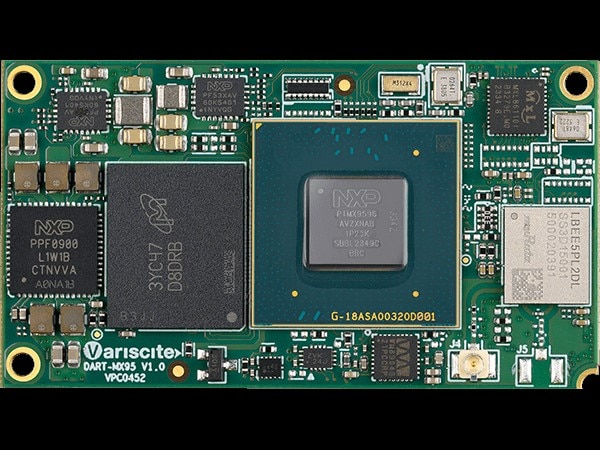 The DART-MX95 is powered by the NXP i.MX 95 SoC and ISO 13485 certified for
a variety of applications.
The DART-MX95 is powered by the NXP i.MX 95 SoC and ISO 13485 certified for
a variety of applications.
Brighter together: Partnerships that Drive Innovation
By combining NXP’s drive for innovation with Variscite’s expertise in SoM
design and manufacturing, this partnership ensures that customers receive
state-of-the-art solutions backed by industry-leading quality standards. NXP
enables Variscite to achieve ISO 13485 compliance thanks to its long-term
support, reliability documentation and security helping to meet certification
requirements efficiently. Key factors include:
Long-Term Product Availability and Lifecycle Management
-
NXP provides long product life cycles ensure medical device manufacturers
can maintain compliance with regulatory requirements for extended periods
-
Many NXP processors within the i.MX portfolio offer 10-15 years of
availability, which is crucial for medical devices that require long-term
stability
High Reliability and Safety Features
-
NXP’s System-on-Chip (SoC) solutions integrate hardware security features,
error correction and redundancy, essential for medical applications
-
These processors meet stringent electromagnetic compatibility (EMC) and
safety standards, aligning with ISO 13485 requirements
Validated Software and Documentation Support
-
NXP provides extensive software validation, medical-use reference designs
and Board Support Package (BSP) support
-
Official compliance documentation, including Failure Mode and Effects
Analysis (FMEA), risk assessments and validation reports, simplifies ISO
13485 certification for manufacturers
Medical-Specific Processors and AI Capabilities
-
NXP processors support NPU accelerators for AI and machine learning (ML)
used in several healthcare applications, aligning with modern ISO
-
Features like low-power operation, real-time processing and advanced
connectivity (Wi-Fi, Bluetooth, Ethernet) make NXP ideal for portable and
embedded medical devices
Clinical Regulation (FDA and EU) for Cybersecurity
-
Many NXP processors, such as the i.MX 8 and i.MX 9 series support NXP’s
EdgeLock® Secure Enclave to enhance medical device security, including:
hardware root of trust, secure boot and anti-rollback, tamper detection and
response, cryptographic acceleration, key management and secure storage
-
EdgeLock SE050 and the
latest
EdgeLock SE052F Secure
Elements provide end-to-end security for connected medical devices, helping
meet clinical regulation for cybersecurity thanks respectively FIPS 140-2
and FIPS 140-3 global security standards
Learn more about
NXP’s partnership with Variscite
and browse through our catalog of SOMs and other solutions for your next
embedded design.