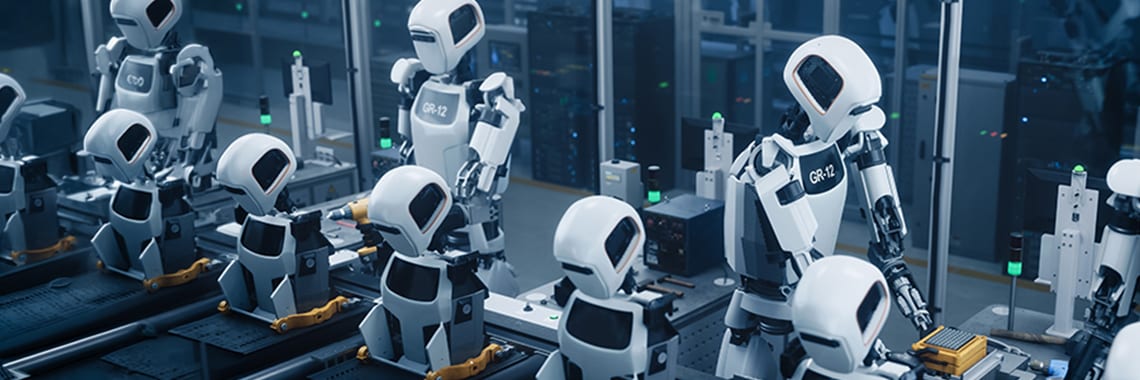
Across the industry, robotics is evolving from AI embodied robots—where AI is simply added to a pre defined mechanical form—to AI defined bodies, where the robot’s morphology, actuation and sensing are shaped around the AI’s capabilities and requirements.
And as this evolution unfolds, we’re reminded of a simple truth—a robot that sees but cannot feel will eventually fail. True autonomy does not begin in high- performance computing, it begins at the sensor edge.
Modern robots increasingly rely on AI-grade computing to run high throughput perception, reasoning and AI inference—the “robot brain” responsible for vision, mapping and planning. Yet even the most capable graphics processing unit (GPU) stack still depends on accurate, synchronized and trustworthy physical sensing of the real world—vibration, temperature, pressure/flow, current/voltage, weight, acoustics and position—before any AI can reason or act on it.
High performance compute may serve as the robot’s brain, but sensors, edge processing and local AI form its nervous system and reflex layer, closing the loop between perception, action and adaptation.
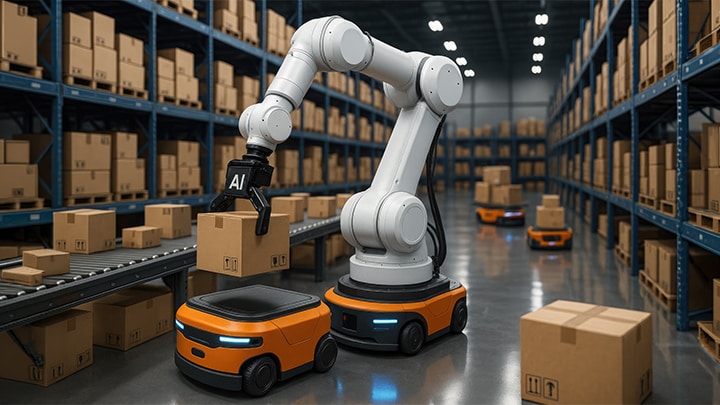 Robot system architecture with sensing, AI compute and real‑time control working together.
How the Physical AI Architecture Comes Together
It’s at the architecture level where you really see how all these pieces come together to form a modern physical AI robot—each part playing a role in a system that thinks, senses and moves as one. This solution offers:
- Sensing and Edge conditioning: The multimodal sensors give the robot awareness of motion, force, temperature, sound and position so that once processed, they become the synchronized, high quality data the system uses for state estimation, control and safe, adaptive behavior
- Perception and AI: Data from the sensing layer becomes raw material for high-performance computing to perform object detection, pose estimation, stereo depth, 3D reconstruction, and visual Simultaneous Localization and Mapping (SLAM) forming the high level intelligence loop
- Control and actuation: High performance compute handles global planning and perception, sending high level motion goals down to fast inner loops allowing real time motor controllers close the torque, velocity and position loops that keep every joint stable, smooth and precise
- Data and analytics: Edge gateways and cloud services fuse multi sensor trends (spectral, thermal, electrical and positional) for condition based monitoring and predictive maintenance
Why Fusion? Why Now?
Once you understand how the architecture layers together—with sensing feeding compute and compute guiding control—you begin to understand why fusion matters. Picture a collaborative arm going about its daily tasks. Deep inside the joint, a tiny 2–3 mA current offset pairs with slow thermal drift in torque feedback. The early signs of bearing wear are there, but buried. The AI may be brilliant, but it can only act on the signals it trusts—fusion can help lift faint clues out of the noise and turn them into something the robot can respond to.
How NAFE Supports Fusion
Across the robotics domain, the shift from single sensor thresholds to multi sensor fusion enables major gains in reliability and autonomy. Studies on robotic joint and motor health show that fusing temperature, current/voltage, vibration and position feedback dramatically improves anomaly detection accuracy—helping identify early signs of backlash, overload, thermal drift or bearing wear long before traditional limits would trigger. In many deployment scenarios, this multi modal fusion translates to 30–45% reductions in unexpected robot stoppages and emergency service events.
For mobile and humanoid platforms, continuous fusion of proprioceptive signals (inertial measurement units—or IMUs—torque sensors and encoders) with environmental sensing (vision, depth, acoustics) strengthens fault detection, navigation robustness and safe reaction behaviors. As robotics teams scale AI driven predictive programs, they report up to a 40% reduction in maintenance effort and around a 50% drop in mission level failures.But this shift only occurs when the AI is supplied with rich, continuous multi sensor data streams from the robot’s body, powertrain and environment.
And this is exactly where NXP’s solution comes in—as fusion only works when every signal enters the system clean, calibrated and aligned NAFE is built to deliver the sensory foundation needed.
This shift toward Physical AI is already reshaping how leading platforms are built. NXP’s latest Physical AI collaboration with NVIDIA highlights the growing need for dense, real-time sensing across the robot body. While NVIDIA Holoscan and NXP edge processors provide the high-performance compute layer, the reliability of these systems ultimately depends on the quality of the sensor data feeding them.
This is where NAFE plays a foundational role—delivering the calibrated, synchronized and multi-modal measurements required for high-integrity fusion, motion control and predictive maintenance in humanoid and mobile robots.
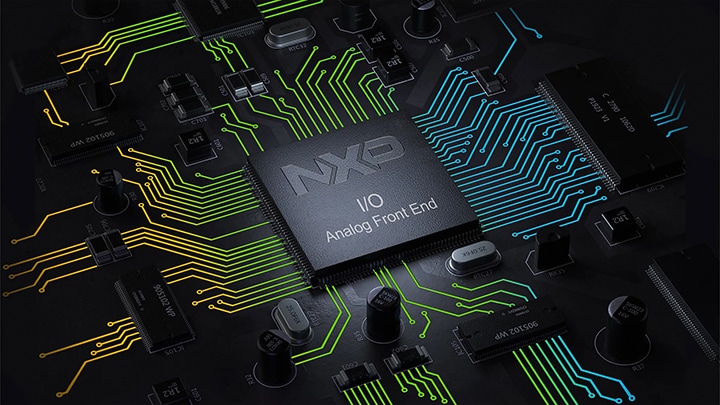 NXP NAFE provides calibrated, time‑aligned analog data as a foundation for sensor fusion.
How NAFE Fuels Sensor Fusion at the Robotics and Industrial Edge
NAFE is purpose built for fusion workflows because it delivers deterministic, low noise, multi modal measurements with shared excitation, synchronized delta sigma conversion and built in diagnostics providing the calibrated, time aligned data foundation that fusion algorithms require. At the core of fusion-driven transformation are two powerful NXP components:
- NAFE13388: An eight-channel, software-configurable input device
- NAFE33352: A single-channel, software-configurable I/O device with two auxiliary universal inputs
Engineered for maximum versatility, these devices support a broad spectrum of analog input and output signals—including 0–5 V, 0–10 V, ±5 V, ±10 V, 0–20 mA, 4–20 mA, ±20 mA and more—while delivering high accuracy (0.01%) and precision (up to 24 bit) for best in class measurements.
Multi Input Hardware Fabric for Fusion
Robotics and predictive maintenance require the capture of multiple sensing modalities. NAFE’s multi channel architecture provides a unified analog front-end (AFE) that allows vibration, temperature, pressure/flow, current/voltage, acoustics and positional signals to be sampled in a tightly controlled, multiplexed manner. Its excellent cross channel isolation and shared clock delta sigma architecture improve inter channel correlation and prevent timing or mismatch errors that can degrade sensor fusion accuracy.
High Accuracy Reveals Early Failure Signatures
The strongest predictors are often subtle—a slight rise in stator temperature under constant load, a faint sideband in a bearing’s spectral envelope or a minor phase skew in inverter currents. The robot motor fusion study underscores how subtle multi signal patterns (temperature + voltage + position) carry outsized predictive weight. NAFE’s precision conversion and low noise floor elevate these weak precursors above the noise so AI and filtering can detect them sooner.
Built In Diagnostics Protect the Fusion Pipeline
Fusion assumes that each channel is trustworthy. With NAFE, open/short detection, out of range flags and calibration/health checks prevent corrupted channels from corrupting the fusion decision. This is essential for keeping false alarms low while retaining early sensitivity—key to achieving the downtime and cost deltas reported by AI driven predictive maintenance programs.
Factory Calibration Scales Across Fleets
Predictive maintenance is a fleet problem. Factory calibration reduces on site tuning, improves unit to unit repeatability and tightens cross asset comparability. This is exactly what sensor agnostic predictive maintenance platforms need to accelerate brownfield deployments.
When these capabilities come together, fusion becomes more practical at scale, moving beyond theoretical implementations. This is why NAFE is increasingly used in the following high ROI edge scenarios:
- Assembly Robots and cobots: Fuse joint vibration, motor currents, gearbox acoustics and temperature reveal early signs of backlash, lubrication loss, or bearing wear allowing multi modal fusion captures subtle cross signal degradation long before motion accuracy is affected
- Material handling systems (conveyors, fans and pumps supporting robotics): Fused data reduces false alarms while improving root cause clarity in rotating equipment by combining vibration spectra, ultrasonic cavitation cues, airflow/pressure and current harmonics to auto triage imbalance, misalignment, looseness or flow restriction
- Industrial power electronics and drives (robotic motion systems): Fuse inverter current/voltage harmonics, thermal rise and mount point vibration detects insulation aging, bearing wear or torque ripple issues while powering robot arms, gantries, conveyors and autonomous machinery, so early detection prevents motion instabilities that ripple into robotic cell performance
- Mobile Robots and autonomous mobile robots (AMRs) (Edge Gateways for Robotic Fleets) Capture wheel motor currents, gearbox vibration, encoder drift and thermal signatures during charging or maintenance intervals using NAFE based edge gateways for a continuous health profile across the AMR fleet, reducing downtime and ensuring safe, reliable robotic navigation and mission execution
Across robotic arms, AMRs and the motion subsystems that keep automated cells running, these use cases all rely on one common requirement—clean, synchronized, multi modal sensor data that can capture the mechanical and electrical signatures of emerging faults. This is exactly what the NAFE ecosystem is built to deliver.
Putting NAFE to Work in Robotics Applications
The NAFE family—spanning precision sigma delta AFEs, high voltage industrial variants and highway addressable remote transducer (HART) enabled options—provides a unified, deterministic measurement architecture that scales from prototyping to production.
With NAFE Universal Sensing Module (USM) evaluation boards, reference designs and ready to run graphic user interfaces (GUIs), teams can deploy sensors and instantly visualize the fused, high integrity data needed for robotic health monitoring and navigation grade signal processing. For developers exploring predictive maintenance, multi sensor fusion or fleet level reliability in robotics, evaluating a NAFE device or universal input module (UIM) kit is the fastest way to experience the measurement quality and integration simplicity firsthand.
NAFE as NXP’s Sensor Fusion Solution for Robotics
Sensor fusion has become the standard in robotics and industrial maintenance because it outperforms single sensor monitoring, improving accuracy and materially reducing downtime and cost. NXP’s NAFE provides a high fidelity, multi input, calibrated, and diagnostic rich AFE that feeds that intelligence with trustworthy signals at scale, across fleets and across time.