- Smarter World Blog
- Smarter Wireless Sensing at the Edge with MCX W23 MCU
Smarter Wireless Sensing at the Edge with MCX W23 MCU

The MCX W23 is a new dedicated wireless microcontroller unit (MCU) platform from NXP for battery-powered sensing devices. It is designed for miniaturized, body-worn, and portable sensors used in medical and smart-sensing applications, but also for actuator-based systems. The MCX W23 offers developers a cost-effective Bluetooth® Low Energy (LE) solution, supported by a complete evaluation ecosystem that includes FRDM boards and sensor shield boards for streamlined testing and rapid development.
Putting Sensors Front and Center
To accelerate the design of medical devices that are smaller, smarter and longer lasting, NXP's new MCX W23 wireless microcontroller platform provides a complete developer-ready ecosystem. It combines compact hardware, highly versatile sensing capabilities and secure Bluetooth LE connectivity. The MCX W23 supports easy integration of multiple sensors, including accelerometers, altimeters/pressure sensors and Hall-effect magnetic switch sensors. This enables seamless wireless smart sensing at the edge, in a solution that is scalable, secure, adaptable and robust.
Made for Miniaturized Medical Applications and More
The MCX W23 MCU is built on the popular Arm® Cortex®-M33 core and operates at 32 MHz. It supports up to 1 MB Flash and 128 kB RAM, in packages as small as 2.5 x 2.6 mm. Power modes support operation down to 1.1 V, extending battery life for critical applications that require continuous sensing, but minimal maintenance. The MCX W23 brings versatile battery support through a flexible power management unit for direct operation from low-voltage silver oxide/lithium coin cells. Its compact footprint and limited external component requirements make it ideal for lightweight, miniaturized designs like medical wearables, connected home devices and asset tags.
Smarter wireless sensing at the edge with MCX W23 MCUs.Watch the video to see MCX W23 Secure Bluetooth LE in action.
Unlocking Sustainable Wireless Sensing
Designing sustainable wireless sensing applications requires a holistic approach that balances energy efficiency and reliability with minimal environmental impact. By leveraging Bluetooth LE MCUs and low-power wake-up sensors, the MCX W23 directly addresses these needs. It enables sensor nodes to operate on extremely low and dynamic power sources, such as small batteries or energy harvesting systems.
FRDM Board Support
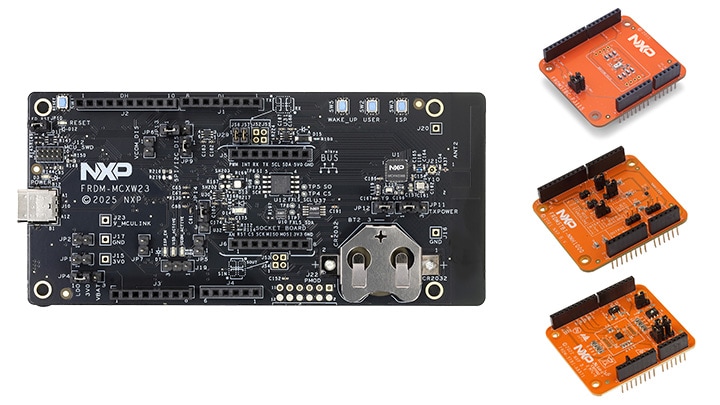
The MCX W23 FRDM platform features a combination of low-power operation and easy sensor integration, giving developers the freedom to innovate. Using the FRDM-MCXW23 board , developers can explore new sensor use cases. Through stackable, modular expansion options, this FRDM board can be expanded with temperature, motion, pressure and magnetic switch sensors, for low-voltage operation and minimal external components. This accelerates the development of compact, wireless devices with staying power—less servicing or downtime. New demos showcasing sustainable sensing in action in the Application Code Hub (ACH) are being released for the FRDM-MCXW23 board and sensor shield add-ons. These ready-to-run demos showcase sustainable sensing in action and are available here.
A Complete Ecosystem, Beyond the Chip
While the MCX W23 FRDM platform is built around the MCX W23 chip, it also extends into a stackable, modular ecosystem centered on the FRDM-MCXW23 development board, including:
- FXLS8974CF (3-axis accelerometer)
- P3T1755DP (temperature sensor)
- Full Arduino expansion header
- Mikrobus™ expansion header
- NMH1000 magnetic switch sensor
- MPL3115A2S pressure/altimeter sensor
- Bluetooth® LE 5.3 via the MCX W23 click board (optional)
Secure, Connected and Ready to Deploy
Built with trust in mind, the MCX W23 supports secure and private data handling that is essential within connected environments such as healthcare. Accurate and trusted data is critical for patient monitoring, while secure boot, debug and over-the-air (OTA) updates ensure reliability in medical-grade use cases. The MCX W23 also delivers strong security foundations, including Security Evaluation Standard for IoT Platforms (SESIP) Level 2 and Platform Security Architecture (PSA) Level 2 certifications. With (Physically Unclonable Function) PUF-based key management, developers can be confident in protecting device integrity and patient privacy from day one.
Beyond the health sphere, the MCX W23 also brings its robust security strengths to consumer electronics, industrial automation and smart energy systems. Here too, data integrity and device protection are cornerstones of reliable, trusted performance.

From Prototype to Product
Medical device design is bringing self-care to healthcare, moving support and treatment closer to the patient and further from the hospital. The demand for IoT devices in the medical market is rising, driven by the need to reduce the workload on healthcare providers while increasing patient comfort and convenience. With its compact size, modularity and secure connectivity the MCX W23 is a natural fit for healthcare devices and equally suited for edge applications such as smart home, industrial monitoring and asset tracking fields.
Whether on the human body or in the field, this is a platform designed for sensing everywhere—built to adapt, stack and scale. The MCX W23 brings together the processing, sensing, security and connectivity that accelerates real-world deployment.
Explore the full experience, from evaluation kits and expansion boards to software examples at nxp.com.
Authors

Rakshit Grover
Rakshit Grover is a Technical Marketing Engineer at NXP, working in Product Marketing for Mass Market enablement. He creates technical content highlighting NXP Products in practical, real world scenarios. He completed his Masters in Engineering Management from Duke University specializing in Product Management and draws upon his past experience working in Product Management within the semiconductor Industry and as an Embedded Systems Engineer in the Medical device and Robotics Industry. Outside work, Rakshit is an avid Table Tennis player and enjoys Meditating.

Amit Purohit
Amit Purohit is a Senior Principal Staff member at NXP Semiconductors, where he drives sensors enablement ecosystem strategies for industrial and medical sensors. His role emphasizes improving customer ease of use and advancing innovative technologies. With over 15 years of experience in semiconductors focused on sensors, compute and connectivity technologies, Amit leverages his extensive expertise to drive impactful solutions and differentiate NXP’s offerings.