- Smarter World Blog
- Why System-on-Modules Are Powering the Next Generation of Embedded Designs
Why System-on-Modules Are Powering the Next Generation of Embedded Designs

When companies set out to design a new device, they face a familiar question— build from scratch or buy a pre-engineered solution? Increasingly, the answer is to buy, but also specifically to build System-on-Modules (SoMs).
Explore NXP's SoMs designing community. View NXP’s i.MX 95 Processor Partner Ecosystem.
SoMs integrate the essential building blocks of an embedded system — processor, memory, power management and key interfaces — onto a compact, production-ready board. Developers can simply design a carrier board around it for a unique application. This results in a proven, scalable foundation that empowers teams to innovate faster.
With the backing of open standards like Smart Mobility Architecture (SMARC) and Open Standard Module (OSM), and a robust global ecosystem of suppliers, SoMs have moved from nice-to-have prototyping tools to mainstream production platforms across industrial, medical and IoT markets.
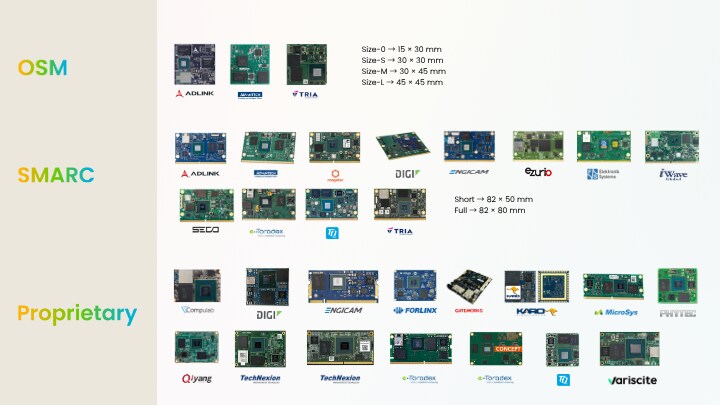
From compact soldered modules to scalable edge-connect solutions, each SoM form factor offers unique advantages. The comparison below illustrates how OSM, SMARC and proprietary designs address different embedded design priorities.
| Feature | OSM Module (SGeT) | SMARC Module (SGeT) | Proprietary Modules (Partner-specific) |
|---|---|---|---|
| Mounting | Soldered (rugged, space-saving) | Edge connector (easy to swap/upgrade) | Flexible, vendor-specific |
| Processor Support | Arm® Cortex®, x86, MCU32 | Arm Cortex, x86 | Arm Cortex, x86 |
| Power Use | Ultra-low-power | Low power | Varies |
| Target Applications | Industrial IoT, edge AI, harsh environments | Multimedia, robotics, automation | Tailored solutions |
| Choosing the Right Module | Solderable and ultralow power, ideal for rugged environments and industrial applications. High scalability for edge computing and AI. | Flexible I/O and display options, great for multimedia, automation and robotics. | Tailored by vendors for specific applications, offering optimized performance and unique features. |
With standardized form factors and a global partner ecosystem, SoMs offer a scalable path from prototype to production.
Valeria Andrade—Partner Marketing Manager
What is driving SOMs Growth?
SoMs are gaining traction across industries, but what’s fueling this rapid adoption? Below are the key forces shaping the rise of SoMs in modern embedded design.
Standards Drive Adoption
What’s behind this momentum? A combination of technical, economic and strategic factors are driving companies to adopt SoMs for their next-generation designs.
Market Momentum
According to Maximize Market Research , the global market for Arm-based SoMs is booming, projected to grow from $2.5B in 2024 to $5.5B in 2032 at a CAGR (Compound Annual Growth Rate) of nearly 11%.
Scaling Up
Once limited to projects under 50,000 units, SoMs are now being deployed in designs exceeding 250,000 devices.
Key Benefits of SoMs
Beyond market trends, SoMs offer tangible advantages that help teams innovate faster and smarter. The following sections outline how they are transforming the development process.
Faster Time-to-Market
Developers skip the complexity of chip-down board bring-up. SoMs arrive prevalidated, allowing teams to focus on application innovation.
Reduced Risks and Costs
With proven designs and pre-certified wireless options, SoMs cut compliance and re-spin cycles.
Scalable Designs
Standardized form factors make it easier to swap or upgrade modules across generations.
Ecosystem Depth
Backed by NXP’s global partners, SoMs come with software, long-term support and life cycle services.
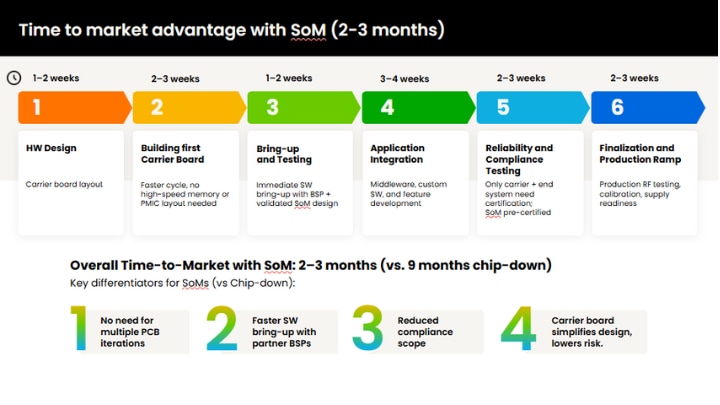
Building Smarter and Faster
SoMs are no longer niche prototyping tools. They are mainstream production platforms powering industrial automation, connected healthcare, robotics and beyond. For companies looking to innovate while reducing risk, SoMs are becoming a popular choice. With NXP’s i.MX 95 ecosystem , the future of embedded design is modular, scalable and ready to deploy.
Authors

Valeria Andrade
Valeria Andrade is the Partner Marketing Manager for NXP who supports marketing strategies for the EBS Partners. With a strong focus on strategic co-marketing initiatives, Valeria collaborates closely with global partners to amplify the reach of NXP’s cutting-edge technologies, including the i.MX processor family helping partners showcase real-world solutions powered by NXP.

Robert Thompson
Robert Thompson is the director of Secure Connected Edge Ecosystem at NXP Semiconductors. He has extensive experience in developing and implementing impactful ecosystems for semiconductor companies. Currently Robert focuses on driving partner adoption and success with NXP’s portfolio of embedded systems products for the Secure Connected Edge business line.