- Smarter World Blog
- World Wi-Fi Day 2025: A Conversation with Tim Donovan
World Wi-Fi Day 2025: A Conversation with Tim Donovan

NXP celebrates World Wi-Fi Day—a global initiative on June 20th that highlights the role of Wi-Fi in connecting communities around the world. In this special edition of Wireless Wednesday, our editors are joined by Tim Donovan, VP of Wireless Connectivity Engineering at NXP, for a conversation about the Wi-Fi standard, its growth and evolution.
Wi-Fi Longevity and Growth
Haley: Wi-Fi has been widely deployed for decades, and it only continues to grow. What causes Wi-Fi to remain as a main method of wireless connectivity, even as other communication protocols gain popularity?
Tim: There are several reasons leading to Wi-Fi’s longevity and continued relevance among wireless technologies. The first is ubiquity. Wi-Fi has been solving the connection problems of society for over two decades and, with that history, it provides solutions to more use cases than any other wireless connectivity technology. Wi-Fi is expected to be available not just at work and at home, but also in the hotel you stay at, the coffee shop you visit, the airport and airplane you travel on — everywhere.
Wi-Fi has already-existing ubiquity in all types of applications. View industrial and consumer/IoT applications that include NXP wireless solutions.
Second is the vast number of use cases that Wi-Fi has the capability to address. With the rich history of Wi-Fi, the companies providing both end products and semiconductors have worked on addressing use cases that demand high throughput, low latency, low power, high system-level capacity, and more. The experience gained through solving these problems has enabled Wi-Fi to satisfy a very wide range of user needs. Other wireless protocols have gained popularity and adoption over the years—such as Bluetooth, UWB, or LoRa—but we see that these technologies do not support that same range of diverse applications, so their adoption has not grown to compete with Wi-Fi’s ubiquity.
Third is how Wi-Fi continues to develop. As the generations progress, Wi-Fi throughput, network bandwidth, security features, and more all improve and advance. This creates a new standard for Wi-Fi devices with every generation defined.

The Evolution of Wi-Fi Generations
Haley: The Wi-Fi standard is continuously improved upon, with every generation more advanced than the last. What really changes from generation to generation?
Tim: Speed and capacity are two of the major focus areas of improvement. To achieve higher throughput, the standard needs to evolve not only for the physical layer speed, but also to improve the protocol efficiency to allow for the significant improvements in throughput the user can enjoy. For example, when the physical layer data rate was increased to 2.882 Gbit/s with the addition of 4K QAM, the achievable UDP throughput of a 160MHz 2x2 Wi-Fi device using the original Wi-Fi protocol would be 51 Mbit/s. Of course, over the many versions of standards, protocol changes have been made to introduce different types of aggregations that enable that same 2.822 Gbit/s physical layer data rate to achieve 2.607 Gbit/s of UDP throughput. Pure “speed” improvements have also required protocol enhancements to be effective.
Other than speed and capacity, Wi-Fi’s continuous evolution brings a wide range of additional benefits, including security enhancements, robustness, rate versus range improvements, ranging capabilities, device discovery capabilities, mesh configurations, peer to peer connections, roaming enhancements, location functions, power-saving features (such as 802.11 power save and TWT) and more.
In general, major standard releases follow approximately a 4-year cycle. Wi-Fi 6 was launched in 2019, and Wi-Fi 7 was launched recently in 2024. The next release, Wi-Fi 8, is scheduled to be in 2028.
Beyond the Standard: NXP’s Differentiated Solution
Haley: NXP provides solutions for the latest Wi-Fi generations. Against competitors who also meet the requirements of new Wi-Fi standards, how does NXP offer differentiated value?
Tim: There are many aspects of putting a Wi-Fi product into production and achieving a certain level of performance that the standard does not specify. A common metric that Wi-Fi chipsets are evaluated for is the rate that can be maintained when operating at range. There is peak performance, and then there is practical performance beyond the standard: which considers range, obstacles and other environmental factors. Many aspects of the implementation of a design can impact this practical performance, the rate a device is able to maintain at range, and achieving optimum performance. This is why you see variable performance in different Wi-Fi devices even though they all support the same Wi-Fi standard. NXP’s Wi-Fi solutions are very competitive in this regard, demonstrating high reliability and performance.
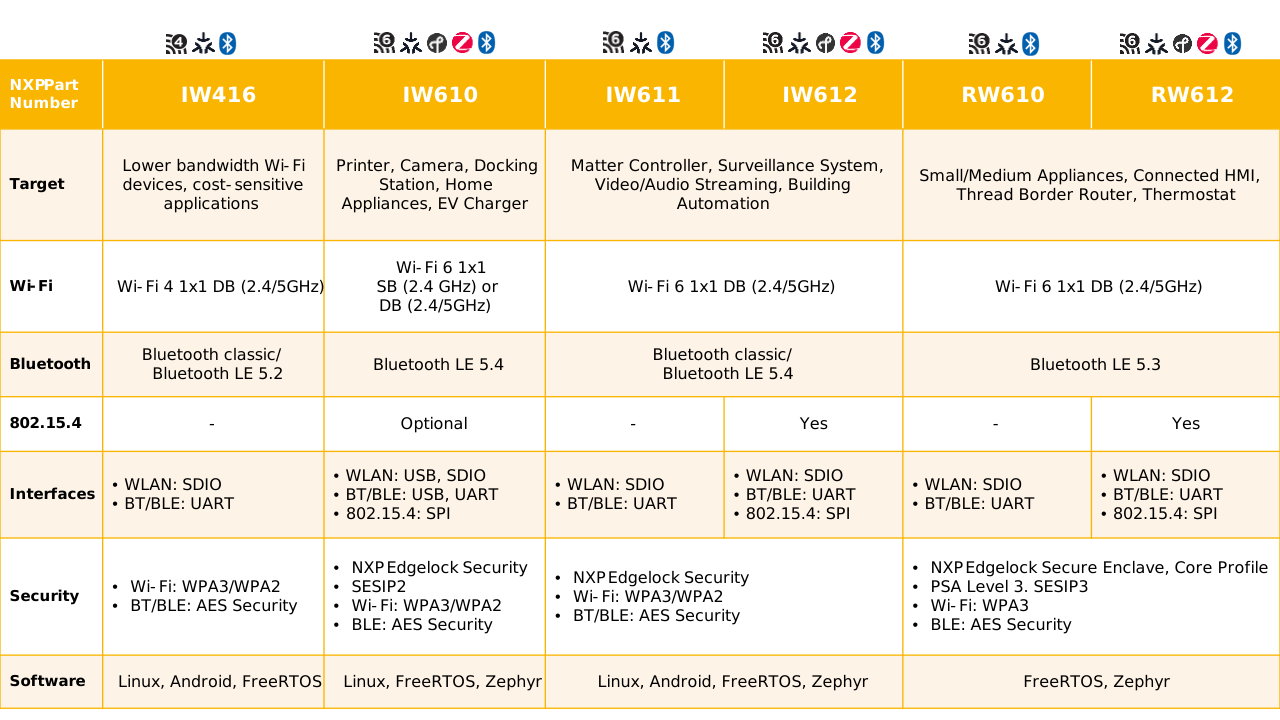
Coexistence with other wireless technologies is another area that allows for differentiation. As you know, most NXP connectivity devices support tri-radio—Wi-Fi, Bluetooth, and 802.15.4. Coexistence allows for these radios to operate simultaneously without interfering with each other or with external radios. How to get three radios to each achieve their needed latency and bandwidth is not something a standard tells you, and it is a clear way to differentiate NXP’s products.
NXP offers differentiated Wi-Fi solutions that demonstrate high performance beyond the defined Wi-Fi standard. Discover how these solutions can elevate your connectivity here.
Supporting challenging use cases is another area for differentiation. For example, when supporting CarPlay, the number of ancillary links that can be supported while achieving the needed latency for the CarPlay link in a noisy operating environment is clearly an area for differentiation. Achieving performance with integrated Power Amplifiers (for lower BOM cost) across a wide range of temperatures is another area to differentiate. And beyond some of these performance indicators, there are things like customer support. Wireless technologies are not easy for customers to produce. There are certifications required for regulatory agencies and standards organizations. Thus, having an infrastructure and module partners that help support customers through some of these challenges is another area of NXP’s differentiation.
Connection and Collaboration Across the Industry
Haley: How does NXP work with the rest of the industry to advance the Wi-Fi standard and contribute to the evolution of this technology?
Tim: Defining a new Wi-Fi standard is a highly collaborative, multi-year process that involves teams from IEEE, WFA (Wi-Fi Alliance), NXP, other Wi-Fi chip manufacturers and device manufacturers.
A task group is first formed to develop the technical specification for the new standard based on industry trends and common problems. Members of this task group include engineers and researchers from many different companies all over the industry: Wi-Fi chip manufacturers and Wi-Fi device manufacturers alike. The task group proposes features and improvements and creates drafts of the standard. These features are tested for performance and feasibility, and the drafts undergo multiple revision cycles. Meanwhile, WFA develops certification programs and marketing, and the design work starts as chip manufacturers build solutions to meet the new standard. Then, hosted by WFA, the chip and device manufacturers convene to test and deploy these solutions to ensure interoperability across brands as well as catch any bugs or issues.
All of this is accomplished through the experience and participation from all corners of the industry, including NXP, other Wi-Fi chip manufacturers and end-device manufacturers along with organizations such as IEEE and WFA. Wi-Fi enhancement is driven by industry collaboration—connection furthers connection.
Authors

Tim Donovan
Tim Donovan is the VP of Wireless Connectivity Engineering at NXP, driving Wi-Fi strategy and solutions. With decades of experience in design and management, Tim has held a foundational role in leading the Wireless Connectivity team since its early days at Marvell Technology and through the NXP acquisition.

Haley Vu
Haley Vu is a Wireless Connectivity Product Marketer specializing in Wi-Fi, Bluetooth and 802.15.4 solutions for Industrial and IoT applications. Drawing on her experience with the NXP Technical Sales Team, Haley brings support and enablement to the broad Mass Market. She holds a B.S. in Electrical Engineering from UC Davis and is based in the Silicon Valley.