Fast Setup Guide for PF8100 PF8200 EVB
Contents of this document
-
Out of the Box
-
Get to Know the Hardware
-
Configure Hardware
-
Install Software
Sign in to save your progress. Don't have an account? Create one.
Purchase your PF8100-PF8200-EVAL-KITS
1. Out of the Box
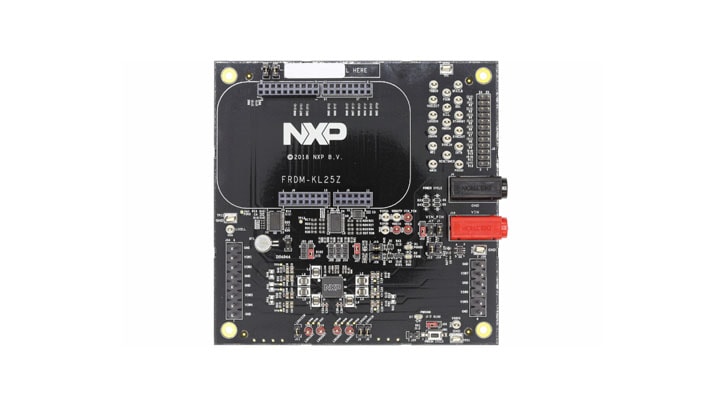
The KITPF8100FRDMEVM/KITPF8200FRDMEVM is an evaluation board composed of all necessary headers, jumpers and signal test points to quickly evaluate NXP products.
This document is intended to help a user quickly set up, configure, and operate the KITPF8100FRDMEVM/KITPF8200FRDMEVM evaluation board.
1.1 Kit Contents and Packing List
Working with the KITPF8100FRDMEVM or the KITPF8200FRDMEVM requires the kit contents, additional hardware and a Windows PC workstation with installed software.
- Assembled and tested evaluation board and preprogrammed FRDM-KL25Z microcontroller board in an anti- static bag
- 3.0 ft. USB-STD A to USB-B-mini cable or USB-Type C cable, this depends on the FRDM-KL25Z board version
- Quick Start Guide
1.2 Additional Hardware
In addition to the kit contents, the following hardware is necessary or beneficial when working with this board.
- Power supply with a range of 3.0 V to 5.0 V and a current limit set initially to 1.0 A (maximum current consumption can be up to 7.0 A)
1.3 Windows PC Workstation
This evaluation board requires a Windows PC workstation. Meeting these minimum specifications should produce great results when working with this evaluation board.
- USB-enabled computer with Windows 7 to 11
1.4 Software
Installing software is necessary to work with this evaluation board. There is one universal GUI for NXP’s Automotive PMIC products, which can be found in the link:
Download and install the latest version GUI in PC.
By using the GUI, the EVB can be operated easily. In this document, we make an example by using the Rev 10.0 GUI. One PF82 firmware can be found in the GUI folder, which may need to be updated for FRDM-KL25Z of evaluation board.
1.5 User Manual
Refer to the UM11160, KITPF8100FRDMEVM/KITPF8200FRDMEVM Evaluation Board, User Guide for full evaluation board functionality.
2. Get to Know the Hardware
2.1 Board Overview
The KITPF8100FRDMEVM or the KITPF8200FRDMEVM provides an easy-to-use platform for evaluating NXP products. The boards support a range of analog, mixed-signal and power solutions. They incorporate monolithic integrated circuits and system-in-package devices that use proven high-volume technology. NXP products offer longer battery life, a smaller form factor, reduced component counts, lower cost and improved performance in powering state-of-the-art systems.
These customer evaluation boards feature the PF8100/PF8200 power management IC. The kits integrate all hardware needed to fully evaluate the PMIC. They integrate a communication bridge based on the FRDM- KL25Z development board to interface with the GUI software interface to fully configure and control the PF8100/PF8200 PMIC.
2.2 Board Features
Buck regulators
- SW1, SW2, SW3, SW4, SW5, SW6: 0.4 V to 1.8 V; 2500 mA; 1.5 % accuracy and dynamic voltage scaling and single, dual, triple or quad-phase configuration
- SW7; 1.0 V to 4.1 V; 2500 mA; 2 % accuracy
- Configurable VTT termination mode on SW6
- Programmable current limit
- Spread-spectrum and manual tuning of switching frequency
LDO regulators
- 4x LDO regulator 1.5 V to 5.0 V, 400 mA: 3 % accuracy with optional load switch mode
- Selectable hardware/software control on LDO2
RTC supply
- VSNVS 1.8 V/3.0 V/3.3 V, 10 mA
- Battery-backed memory including coincell charger with programmable charge current and voltage
System features
- 2.5 V to 5.5 V operating input voltage range
- USB to I2C communication via the FRDM-KL25Z interface
- Selectable hardwire default PMIC configuration or OTP/TBB operation
- Fast mode I²C communication at 400 kHz (high-speed operation supported by PMIC)
- Advance system monitoring/diagnostic via PMIC and/or system AMUX
- Controller/target interface connector
- Onboard I/O regulator with 1.8 V/3.3 V selectable output voltage
Attached FRDM_KL25Z
- The FRDM KL25Z is an ultra-low-cost development platform for Kinetis L Series KL1x (KL14/15) and KL2x (KL24/25) MCUs built on Arm® Cortex®-M0+ processor.
- Features include easy access to MCU I/O, battery-ready, low-power operation, a standards-based form factor with expansion board options and a built-in debug interface for flash programming and run-control.
2.3 Board Description
The KITPF8100FRDMEVM/KITPF8200FRDMEVM are hardware evaluation boards that allow the full evaluation of the PF8100/PF8200. The PF8100/PF8200 family of devices feature power management- integrated circuit (PMIC) designed for high-performance applications based on NXP's i.MX 8 and S32x processors, and on other non-NXP processors. It features seven high-efficiency buck converters and four linear regulators for powering the processor, memory and miscellaneous peripherals.
Built-in one-time programmable memory stores key startup configurations, drastically reducing external components typically used to set the output voltage and sequence of external regulators. Regulator parameters are adjustable through high-speed I²C after startup offering flexibility for different system states.
The PF8100/PF8200 family comprises two versions of this PMIC, to address different market needs:
- PF8200 is the flagship version of this family, providing a full feature PMIC with integrated functional safety mechanism to comply with the ISO 26262 standard and providing a powerful and flexible solution for ASIL B/D automotive modules
- PF8100 is the nonsafety version of this product, providing the power management and digital control included in PF8200, without the functional safety overhead to provide a more economic platform for nonsafety systems
The key features are listed in Table 1.
| Device | Description | Features |
|---|---|---|
| PF8100 | Power Management Integrated Circuit (PMIC) for high-performance processing applications. |
|
| PF8200 | PMIC for high-performance processing applications. |
|
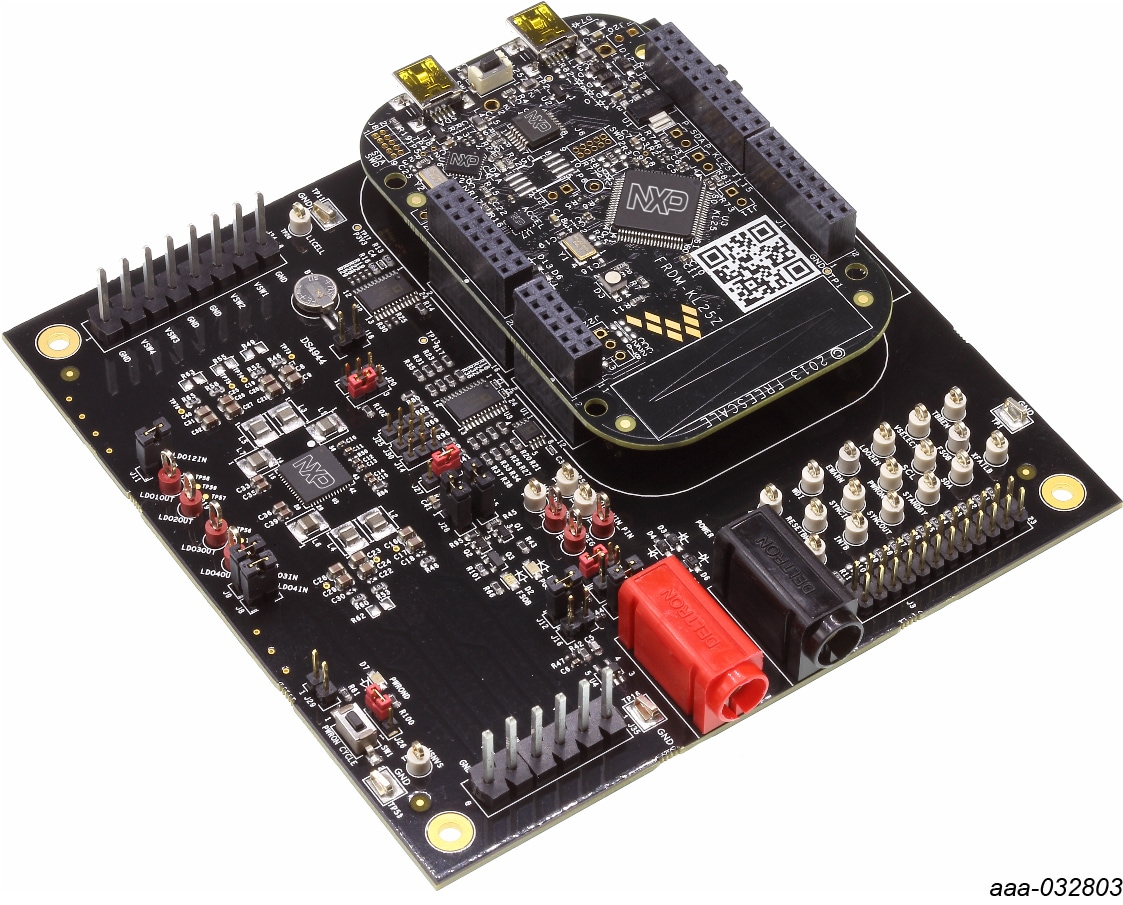
Multiple Board with FRDM-LKL25
The Figure 1 consists of a multiple board with FRDM-LKL25 as shown in the final assembly below.
3. Configure Hardware
3.1 Hardware Configuration
This section summarizes the overall setup. Detail description is provided in the user guide.
Suggested equipment’s needed for test:
- 3.0 V to 5.0 V power supply (using banana jacks)
- Computer
- Mini USB type A Cable
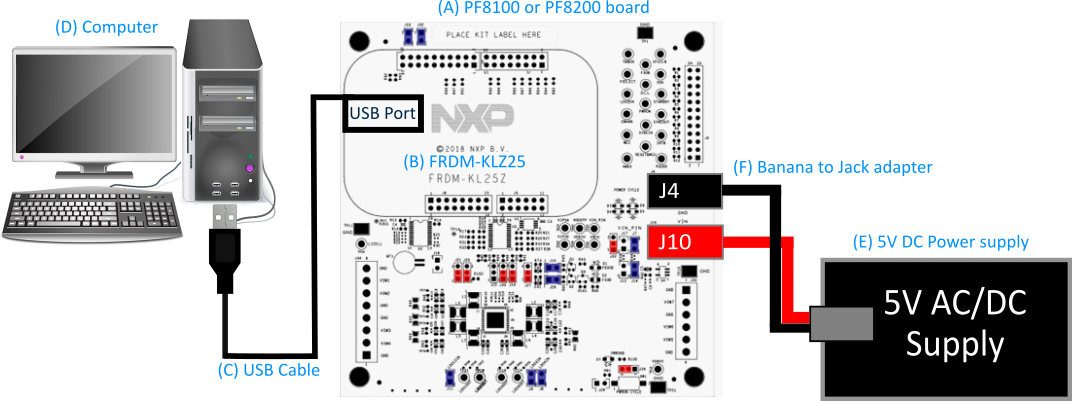
3.2 Configuration Image
3.3 Device Considerations
It is recommended to learn about the device and its specifications prior to operating the boards. The device has a high level of flexibility due to parameter configuration available in the OTP. This impacts the functionality of the device. It is key to understand how the parameters are programmed on the device.
3.4 Setting up the Board
Follow the steps to configure the hardware and workstation as illustrated.
-
With the USB cable connected to the PC and the USB port in the freedom board, apply VIN to the evaluation board
- Provide external VIN between 2.5 V to 5.5 V on
J10(VIN) andJ4(GND) -
Short jumper
J17to provide 3V3 Vin from Freedom board (use this mode of operation for functional demonstration only, no regulation loading allowed in this mode)
- Provide external VIN between 2.5 V to 5.5 V on
- Press Reset on the Freedom board, to ensure board is properly recognized.
4. Install Software
4.1 Downloading the GUI
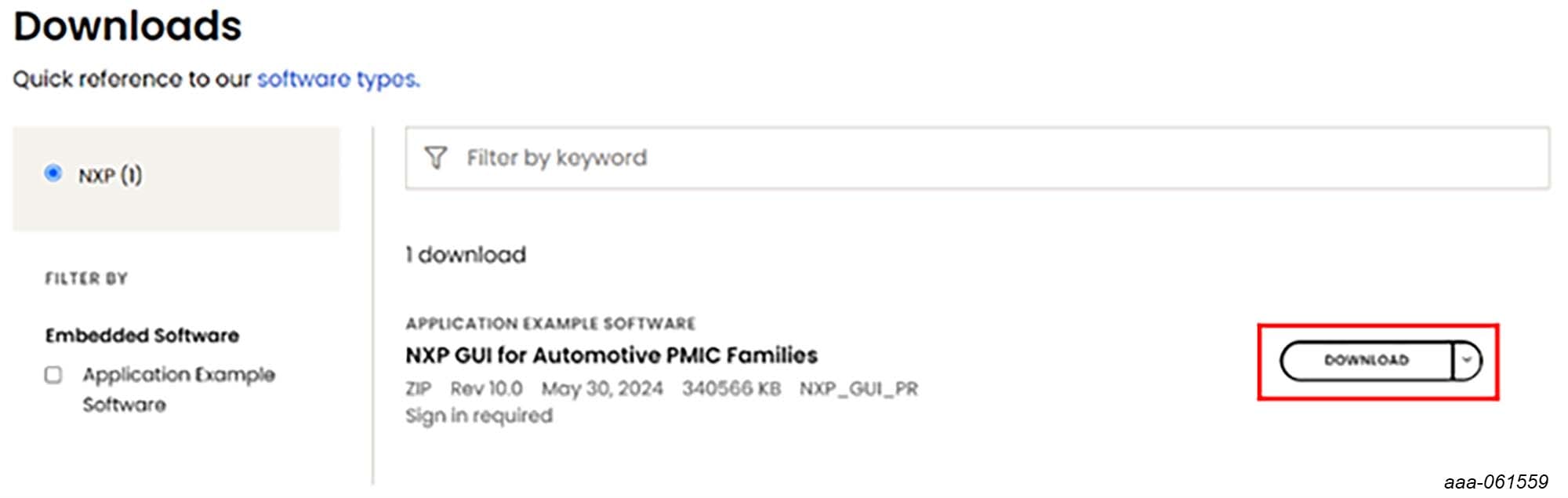
- Sign in to the NXP website and open the link of NXP GUI for Automotive PMIC Families, and then download the zip files. Read the agreement for the GUI and if everything is okay, accept that. The download will start to the location you select.
- Go to the folder location in which the GUI package is saved, unzip the files and open them. The files in the folder should be as below:

4.2 Installing and Opening GUI
- Open the "
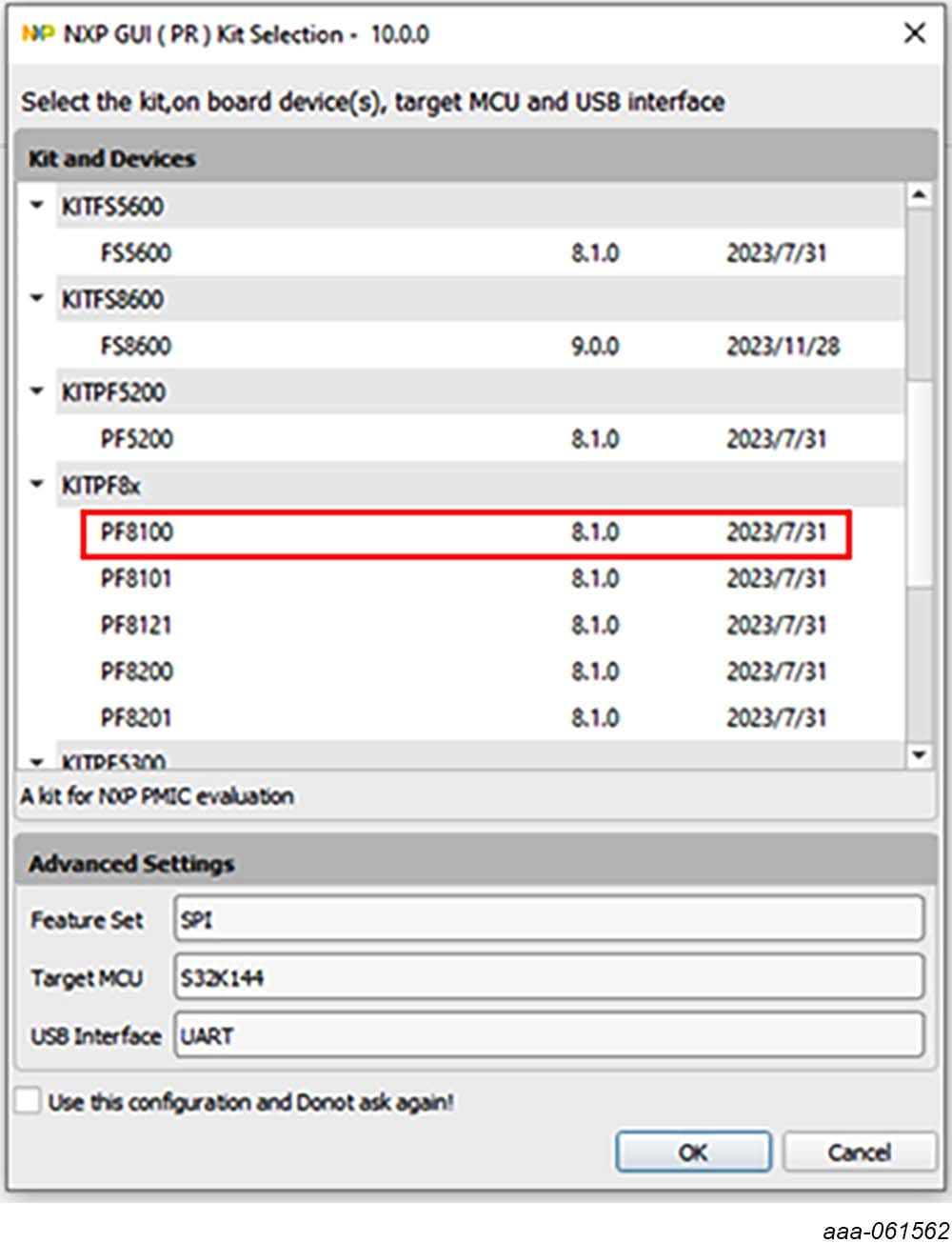
1-NXP_GUI_Setup" folder and click the file named "NXP_GUI-10.0.0-Setup.exe", then the GUI will be installed in the PC - After the installation, open the GUI. One GUI interface, which integrates multiproducts of the NXP Auto PMICs, can be found as below. Select the PMIC product on the evaluation board and open that. For example, if the evaluation board is KITPF8100FRDMEVM, select PF8100 and click OK.

4.3 Updating the PF8100/PF8200 Firmware
The FRDM-KL25Z freedom board is used as a communication bridge to interface the GUI with the PMIC and other I²C devices. The firmware is organized in three levels:
- At the first level, the SDA uses the bootloader to operate as the main path to flash the functional code of the SDA processor. The bootloader is preprogrammed on the FRDM-KL25Z freedom boards and cannot be reflashed to avoid permanent damage to the Freedom board
- At the second level, the SDA provides a firmware loader for a drag and drop update of the KL25Z MCU firmware
- At the third level, the KL25Z MCU provides the GUI firmware in charge of converting the USB communication into MCU instructions to control digital I/Os as well as I²C communication to the PMIC
If the FRDM-KL25Z is not loaded with the correct firmware to support a future software upgrade, the firmware can be updated in a few simple steps.
4.4 Flashing the FRDM-KL25Z Firmware Loader
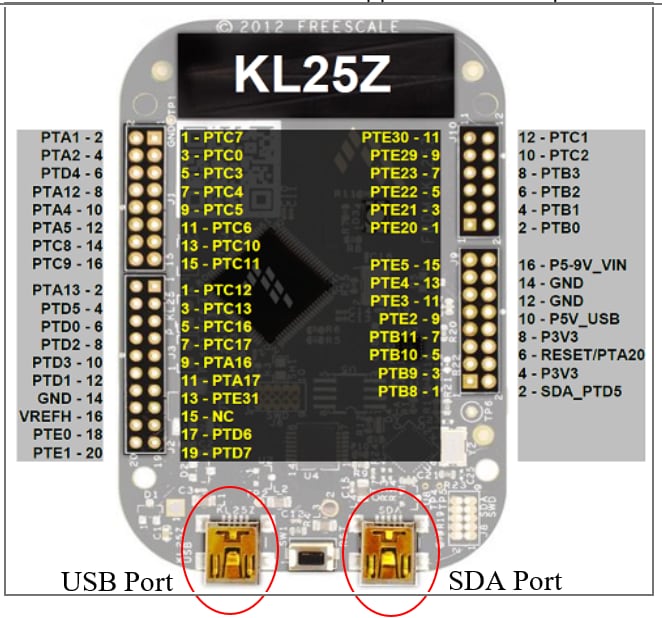
- Press the push button on the FRDM board and connect the USB cable into the SDA port on the FRDM board. A new BOOTLOADER device should appear on the left pane of the file explorer
- Drag and drop the file MSD-DEBUG-FRDM-KL25Z_Pemicro_v118.SDA into the BOOTLOADER drive. File should be located in the KL25Z firmware folder
- Disconnect and reconnect the USB cable into the SDA port (this time without pressing the push button). A new device called FRDM_KL25Z is installed on the PC

4.5 Flashing the GUI Firmware
If a new software or silicon release requires a firmware update on the FRDM-KL25Z freedom board, use the following procedure to upgrade or downgrade the firmware of the freedom board as needed. Note that this procedure is needed only to update the firmware and may be skipped if no change is needed.
- Connect the USB cable in the SDA port (without holding the pushbutton)
- Locate the ""
.bin"" GUI driver to be installed, for examplenxp-gui-fw-frdmkl25z-usb_hid-pf8x00_v0.16.bin, drag and drop the file into the FRDM_KL25Z driver - Freedom board firmware is successfully loaded

Design Resources
Board Documents
Chip Documents
Additional References
In addition to PF8100/PF8200 Customer Evaluation Boards, visit:
Product Pages
- i.MX8X: i.MX 8X Family - Arm® Cortex®-A35, 3D Graphics, 4K Video, DSP, Error Correcting Code on DDR
- S32V234: Vision Processor for Front and Surround View Camera, Machine Learning, and Sensor Fusion
Hardware Pages
Application Pages
Automotive
- Automotive High Performance Compute
- Automotive and Industrial Vision Systems
- Entry Infotainment/Connected Radio
- Front View Camera
- Gateway
- Intelligent Roadside Unit
- eCockpit
- Surround View and Sense Park Assist System Industrial
- Vision, Advanced Sensing, and Processing Board
Networking
Software page
Support
Forums
Connect with other engineers and get expert advice on designing with the PF8100-PF8200-EVAL-KITS evaluation board using our community sites.