The evolution of in-cabin human machine interfaces (HMIs) is reshaping how drivers interact with vehicles, especially as safety, user experience and automation converge. NXP’s i.MX 95 applications processor supports this transformation with scalable, safety-compliant performance tailored for complex automotive environments.
Functional safety is one of the primary drivers of the industry’s HMI transformation. Regulatory bodies are pushing for stricter standards for complex vehicle systems. This is evidenced by initiatives like the Euro New Car Assessment Programme (NCAP) focus on Driver Monitoring Systems (DMS), with plans to incentivize systems that can detect impaired and distracted driving. Also note the National Highway Traffic Safety Administration's (NHTSA) consideration of Advanced Notice of Proposed Rulemaking (ANPR) regarding driver monitoring that can address driver engagement issues. These systems will trigger actions like adjusting Advanced Driver Assistance Systems (ADAS) sensitivity or initiating evasive maneuvers. Euro NCAP's phased approach that emphasizes reliable driver status detection alongside NHTSA's exploration of driver engagement metrics highlight DMS’s increasing importance.
Next-gen vehicles require next-gen safety. Explore how NXP’s i.MX 95 processor is engineered for functional safety.
This safety focus uncovers the limitations of traditional quality management (QM) display solutions, particularly for vehicle clusters. As safety-critical applications increase, display demands will grow. Traditional solutions struggle with these requirements, necessitating more robust display technologies.
SAE Level-3 (L3) autonomy amplifies HMIs' critical role. With SAE Level-3 vehicle automation, drivers can relinquish control, but must be ready to resume it seamlessly. This handover requires clear, intuitive HMI cues. The HMI must provide timely, unambiguous information about the vehicle's state, environment and driver response as ambiguity has serious safety implications.
Robust HMIs are paramount for safe SAE Level-3 deployment. They must ensure driver engagement, even when the driver is not actively driving, requiring innovative solutions beyond simple alerts and potentially including haptic feedback, contextual information and personalized profiles.
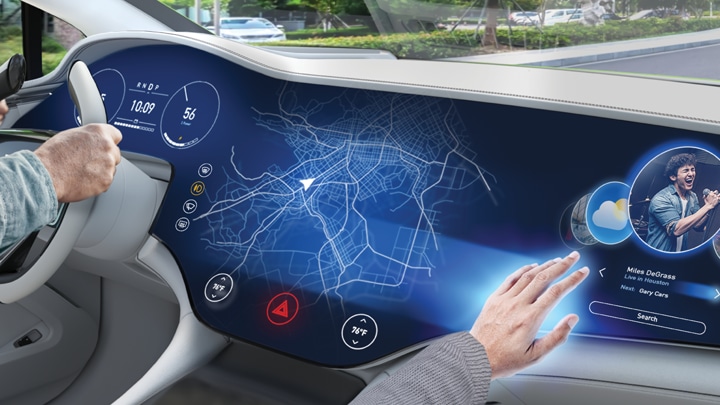 The nature of human-vehicle interaction is being reimagined, driven by innovation and connectivity.
In-cabin HMI evolution is a fundamental shift toward integrated, proactive vehicle safety. By leveraging advanced technologies and adhering to functional safety standards, the industry is building a future where human-vehicle interaction is seamless, intuitive and safe. This requires a concerted effort from all stakeholders.
Using DMS as a case study with an emphasis on functional safety, let's explore architecting application processors for evolving in-cabin HMI requirements.
What is a Driver Monitoring System (or DMS, in Short)?
A DMS monitors driver behavior, alerting the driver and/or system when distractions or fatigue are detected. It continuously monitors for alertness and detects drowsiness, using reliable eye-tracking and gaze detection. Beyond alertness, a DMS can identify drivers according to personalized settings. Critically, it ensures real-time sensor data processing for timely warnings.
As for the functional safety aspects of DMS, while direct control of safety-critical ECUs (for example, Level 2/3 autonomous driving) is outside our scope, the principles discussed can be extended. We focus on the DMS as a standalone warning system, acknowledging future integration potential. This allows us to address specific functional safety challenges within the DMS.
To address these challenges, NXP’s i.MX 95 applications processor family offers a compelling solution. Designed with functional safety at its core, the i.MX 95 targets ASIL D systematic and ASIL B random metrics under ISO 26262:2018 and SIL-2 metrics under IEC 61508:2010. Its real-time safety domain enables isolated execution of safety-critical tasks, ensuring reliable performance even in complex HMI environments like DMS. The processor’s architecture supports Safety Element-out-of-Context (SEooC) development, making it ideal for modular safety integration. With TÜV SÜD certification underway, the i.MX 95 provides a robust foundation for building scalable, future-proof and safety-compliant in-cabin systems .
Driver Monitoring System Functional Safety Concept
Our functional safety concept for a DMS outlines the information flow and ASILs. The process begins with image acquisition (ASIL-B) and transmission (ASIL-B). Image processing (ASIL-B) determines driver state, analyzing for distraction, fatigue, etc. Then, the processed information is transmitted (ASIL-B). The DMS may warn the driver (ASIL-A/B) and/or notify other systems/take action, such as adjusting ADAS or initiating a controlled stop.
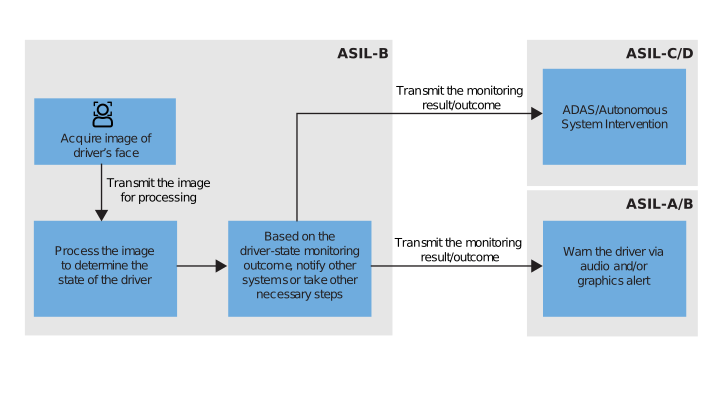 Above are the DMS requirements for the HMI case study.
 For a better experience, download the
block diagram.
Note: The ASIL levels presented here are for illustrative purposes only. Actual ASIL requirements may vary depending on the specific implementation and context of DMS usage within the ADAS/AD system.
DMS Functional Requirements and ASIL Considerations
Let’s look at DMS functional requirements and ASIL considerations with an emphasis on safety.
- The DMS workflow starts with image acquisition (camera, resolution, frame rate, field of view)
- Transmission is made secure, with sufficient bandwidth and minimal latency
- Image processing (machine learning, for example: CNNs or LSTMs) determines driver state
- Accuracy and processing time are critical
- The DMS can warn the driver (audio/graphical alerts) and notify other systems/trigger vehicle actions (for example, ADAS adjustments)
- ASIL considerations:
- Image acquisition/warnings (ASIL-B)
- Image processing/notification (ASIL-B/ASIL-B/C)
- ADAS/Autonomous System Intervention (ASIL-C/D)
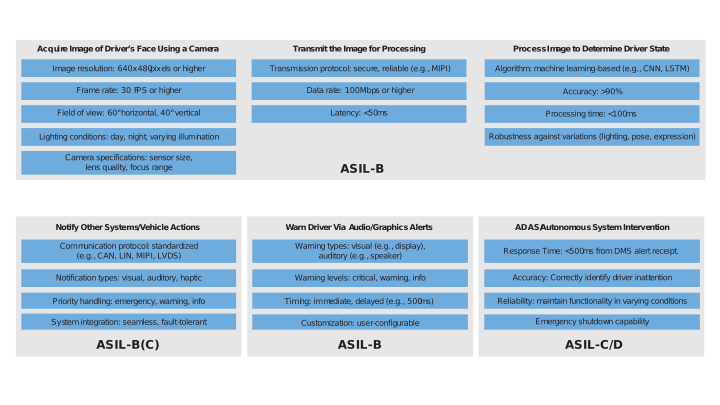 HMI case study: DMS requirements.
 For a better experience, download the
block diagram.
Note: The ASIL levels presented here are for illustrative purposes only. Actual ASIL requirements may vary depending on the specific implementation and context of DMS usage within the ADAS/AD system.
DMS Technical Concept
Now we explore the DMS technical concept, focusing on key elements. Performance requirements (such as image resolution, frame rate, processing speed, accuracy and response time) must align with system goals and ASIL levels. Efficient DMS design balances performance, power and die area. Scalability and flexibility are essential, and the i.MX 95 processor family addresses these needs with a scalable architecture, integrated safety domain and support for ASIL B/D requirements, making it well suited for DMS implementations in safety-critical environments.
Functional safety also requires a robust concept addressing potential hazards—such as ASIL-B for camera/HMI system on chip (SoC), ASIL-C/D for ADAS/AD interface, ASIL-A/B for display/audio. Hardware/software safety mechanisms (such as redundancy, error detection and runtime monitoring) are combined. OS choice balances performance and safety (real-time operating system, or RTOS for performance and a safety-certified OS). The diagram below shows a separation between HMI SoC (Sense) and the ADAS/AD unit (Plan, Act). These elements enable a robust and efficient DMS.
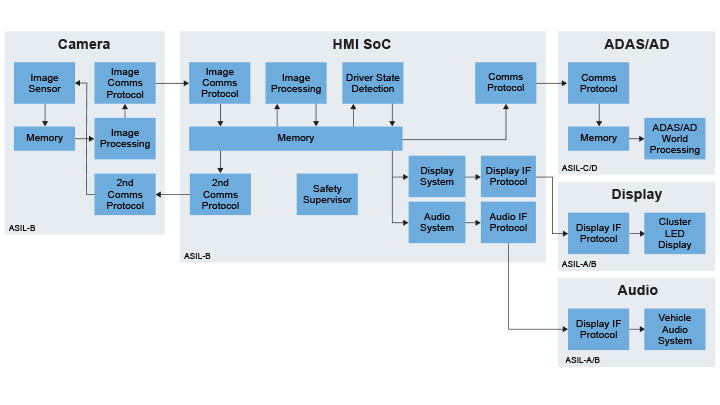 System architecture for ASIL requirements address the evolving demands of in-cabin experiences.
 For a better experience, download the
block diagram.
Note: The ASIL levels presented above are for illustrative purposes only. Actual ASIL requirements may vary depending on the specific implementation and context of DMS usage within the ADAS/AD system.
Shaping the Future of In-Cabin HMIs
The evolution of in-cabin HMIs is driven by increasing safety demands, enhanced user experience, autonomous driving, technological advancements, evolving regulations and innovation. This landscape presents both opportunities and challenges.
The journey toward sophisticated and safer HMIs requires a holistic approach, from technical concepts to functional safety. The DMS exemplifies the complexities involved. From image acquisition to system interventions, each stage demands attention to performance, reliability and safety.
Accelerated execution is crucial, so optimizing chip execution and performance through integrated system-to-silicon design, prioritizing functional safety is paramount. This necessitates collaborative innovation across the automotive ecosystem, driving the development of highly-integrated and efficient processing solutions such as those found in NXP's i.MX processor family. Future-proofing HMIs depends on collaboration, rigorous testing and continuous improvement, leveraging advanced architectures designed specifically for the rigors of automotive applications.
Functional safety is paramount, so adhering to standards such as ISO 26262, SOTIF and ASIL compliance is essential for next-generation HMIs. This focus on safety must be embedded throughout the product development life cycle. Furthermore, as AI becomes increasingly integral to HMI functionality, ensuring its safe and reliable integration is critical. Addressing the unique safety challenges posed by AI, such as adherence to emerging standards such as ISO PAS 8800 for safe AI, will be essential for building trust and ensuring the overall safety of these advanced systems.
Scalability and reliability are essential for long-term HMI success. Adapting to new requirements, integrating with other vehicle systems and maintaining reliable performance are critical.
The future of in-cabin HMIs is bright, transforming the driving experience and enhancing automotive safety. By embracing innovation, prioritizing functional safety and fostering collaboration, the industry can unlock HMIs' potential and pave the way for a safer, more connected driving future. Learn more about how NXP’s i.MX 95 processor helps support the industry's push toward safer, more intelligent in-cabin systems.