NXP's MCU-centric solution adds smartphone mirroring to entry-level digital connected clusters (DCC). With rider essentials now to integrate on clusters, there are even more advanced features coming to the real-time (RT) road map.
Smarter Rides and Simpler Tech
Riders can now easily access their everyday smartphone apps right on their dashboards without the cost or complexity of a full infotainment system. With NXP’s i.MX RT1170 microcontroller unit (MCU), entry-level digital connected clusters are getting a major upgrade. With seamless phone mirroring from smartphones, two-wheelers can now offer glanceable, rider-friendly features like navigation, music and calls, all in a lean, cost-effective package. The i.MX RT1170 MCU powers this transformation, enabling a smarter and more connected riding experience.
Safety Meets Simplicity
The benefits of phone mirroring are immediate and game-changing. No more fumbling with your phone while steering or relying on fragile mounts exposed to the elements. Now, your smartphone’s screen is mirrored directly onto a weather-resistant display built into the cluster, so riders can keep their phone safely stashed in a pocket or storage compartment. This hands-free setup minimizes distractions and maximizes convenience, putting navigation, music and communication right where you need them—front and center of your ride.
Experience the Two-wheeler Experience Shifting into High Gear.
Explore how our i.MX RT1170 MCU is keeping riders connected and focused on the road.
Phone Mirroring is a Win-Win
Traditional phone projection often requires extra hardware like a dedicated video decoder, driving up the bill of materials (BOM) and overall system cost. But our i.MX RT1170-based entry-level cluster changes that. By handling the most-requested phone mirroring flows entirely in software, it eliminates the need for costly components, in turn delivering a sleek, budget-friendly solution without compromising on rider experience.
For original equipment manufacturer (OEMs), it’s a smart use of existing hardware. For riders, it’s the connected convenience they’ve been waiting for. And while future RT devices will continue to develop, the i.MX RT1170 MCU already hits the sweet spot—high impact and low cost.
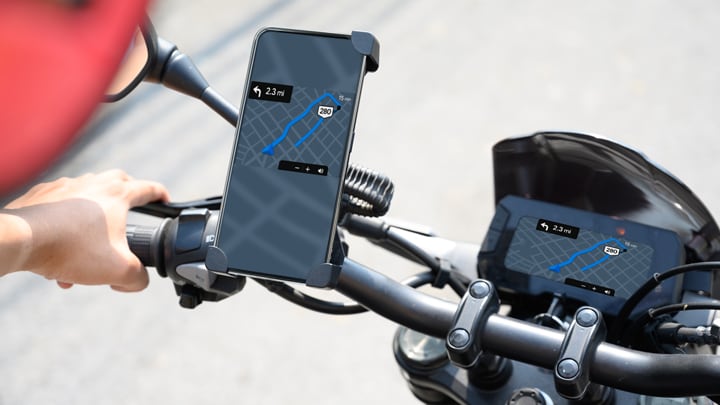 See how NXP’s i.MX RT1170 MCU mirrors the rider’s smartphone display onto their bike’s cluster, delivering navigation, music, calls and more.
i.MX RT1170 MCU Dual-Core Architecture
The i.MX RT1170 is a crossover MCU that blends microprocessing unit (MPU)-like performance and graphics with MCU-like real-time behavior, cost and ease of use. It features dual Arm® Cortex® cores (an M7 up to 800 MHz and an M4 up to 400 MHz), up to 2 MB on-chip static random access memory (SRAM), a 2D graphics processing unit (GPU) with vector graphics acceleration and rich connectivity. Supported by the MCUXpresso software ecosystem, it is a practical foundation for graphics-forward connected clusters.
To unlock mirroring performance, the software architecture makes deliberate use of both cores. Workload is partitioned across the M7 and M4, separating CPU- and bandwidth-intensive tasks from essential cluster duties. Everything runs in a compact, real-time software environment (FreeRTOS), which keeps integration straightforward, and the solution affordable for entry-level designs.
How Phone Mirroring Works in i.MX RT1170 MCU
The design for phone mirroring combines several elements for a seamless experience. Here’s a detailed breakdown of the components and how they work together.
- Connection setup: The phone connects as a Wi-Fi® station and Dynamic Host Configuration Protocol (DHCP) client to the i.MX RT1170 MCU, which acts as a Wi-Fi access point and DHCP server using the AW611 module
- Screen capture and transmission: Phone app captures screen and encodes it as MJPEG, sent over transmission control protocol/internet protocol (TCP/IP) to i.MX RT1170 MCU.
- The i.MX RT1170 MCU decodes the MJPEG stream to YUV, converts it to red, green, blue (RGB) via the Pixel Pipeline and renders it on the LCD touchscreen through mobile industry processor interface display serial interface (MIPI-DSI)
- Touch events on the LCD are captured by the i.MX RT1170 MCU and transmitted back to the phone over TCP/IP for remote control
- Frame rate control: The i.MX RT1170 MCU provides FPS feedback to the phone, which dynamically adjusts its transmission rate based on this input
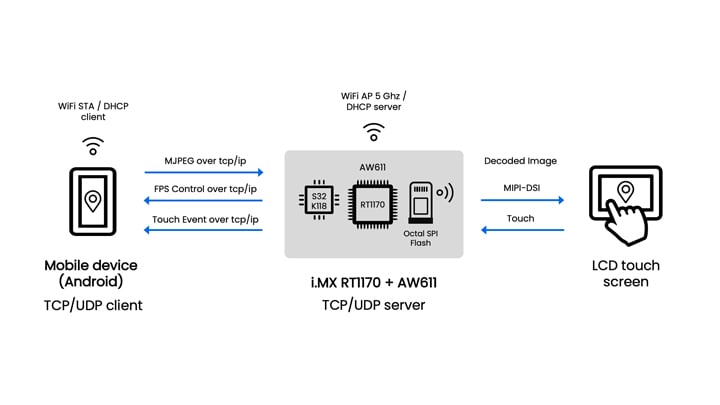 Phone mirroring diagram based on NXP’s i.MX RT1170 MCU.
Familiar Features with Built-in Connectivity
DCC transform the riding experience by bringing familiar smartphone functions to the cluster display. With seamless connectivity between the rider’s phone, display and headsets, staying connected becomes effortless. Riders can answer calls, view message alerts, select contacts, control playback and even share tunes with a pillion, all while allowing riders to stay focused on the road. Along with providing convenient entertainment, the connected platform also unlocks practical features such as “find my bike”, making rides smarter and intuitive.
What’s Coming Next
Along with transforming two-wheelers, the i.MX RT1170 MCU is already proving its value in cost-optimized digital clusters for cars, showcasing a scalable path across vehicle lines. For OEMs exploring connected clusters for electric scooters, bikes or mopeds, this platform offers a compelling mix of user experience, affordability and faster time to market.
Current i.MX RT1170 MCU programs continue to evolve through software upgrades, over-the-air (OTA) updates, user interface (UI) enhancements and region-specific feature packs. This means you can start with phone mirroring today, expand across models tomorrow and grow with the same software tools and ecosystem partners without starting from scratch. Interested in learning more about two-wheeler mobility? Dive deeper into our two-wheeler digital connected cluster solutions.