The rapid shift toward smart car access has redefined how drivers interact with their vehicles. As the Car Connectivity Consortium® (CCC) Digital Key specifications mature, gain traction and are rapidly adopted in the market, the automotive ecosystem increasingly relies on Secure Elements (SE). Secure Elements safeguard digital identities, authenticate users, and ensure seamless interaction between mobile devices, smart key fobs and vehicles. In this evolving landscape, these components are no longer optional — they are essential building blocks for trust in connected vehicles.
NXP’s latest automotive-qualified SE, the NCJ39, takes this foundation to the next level. While Secure Elements have become indispensable for enabling interoperable digital key ecosystems, the NCJ39 expands their role by adding new layers of resilience, performance and flexibility tailored to the demands of modern vehicles. A qualified Secure Element takes this foundation to the next level.
Secure Elements: The Backbone of Modern Digital Key Ecosystems
As digital key adoption accelerates, Secure Elements have emerged as critical components that protect sensitive credentials and cryptographic operations. Their importance stems from several core attributes:
- Tamper resistant hardware designed to withstand physical, side channel, and fault injection attacks, proven through certifications like Common Criteria EAL5+
- Isolated execution environments that ensure security critical
- Standards‑based interoperability built on industry standards such as CCC, JavaCard, and GlobalPlatform, enabling digital keys to work reliably across smartphones, smart fobs, smart cards, and vehicle systems.
This reliability is indispensable in a world where digital keys rely on multiple wireless technologies — UWB, BLE, and NFC — and must operate flawlessly even under constrained conditions such as drained smartphone batteries or low power states. The SE acts as the trusted vault that ensures each authentication exchange is legitimate, verified and protected.
Key architectural capabilities of the NCJ39 include:
- Arm® Cortex® M33 based processing for efficient secure computation
- Large user memory supporting multiple JavaCard™ applets for secure digital key and authentication applications
- High-speed cryptographic co-processors for symmetric and asymmetric operations
- AIS31 compliant hardware random number generator to ensure strong cryptographic entropy
- Dual CRC engines for high integrity data checking
These features enable the NCJ39 to execute sensitive security functions swiftly and reliably — crucial for user facing experiences where delays or authentication failures are unacceptable.
 NXP Secure Element (SE) architecture
Learn how NCJ39 Secure Element advances smart car access architectures.Visit nxp.com/ncj39 to learn more.
Strengthened by Certification and Automotive Grade Design
Designed to withstand the harsh and varied conditions of vehicle environments, the NCJ39 is fully AECQ100 Grade 2 qualified, ensuring consistent performance from –40°C to +105°C.
Its Common Criteria EAL5+ certification verifies that both its hardware and security architecture meet high international standards for tamper resistance and secure execution.
The device is also part of NXP’s EdgeLock® Assurance program, reinforcing security by design principles and providing OEMs with lifecycle-wide confidence that the embedded security foundation aligns with industry’s best practices.
A Strong Fit for Digital Key and Authentication Use Cases
As digital key adoption broadens to include smartphones, key fobs, smart cards and other access form factors, the NCJ39 is engineered to fit seamlessly into such systems. It supports the use of JavaCard based CCC digital key applets, providing:
- Secure storage and management of digital keys
- High performance cryptographic operations for vehicle authentication
- Compatibility with NFC, BLE and UWB-based architectures, optimized to work with NXP’s connectivity portfolio
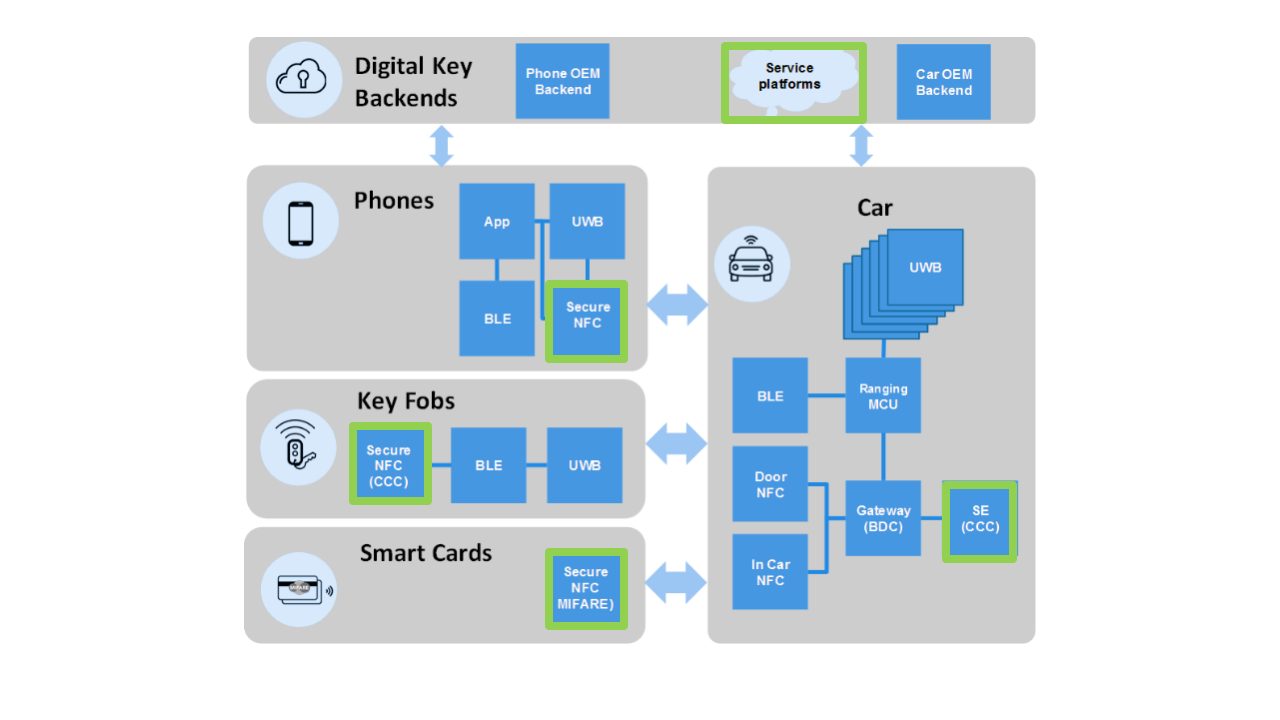 Smart car access – High level architecture
Beyond digital keys, the NCJ39 also supports Qi authentication as standardized by the Wireless Power Consortium and secure communication between internal and external vehicle components, establishing it as a versatile security anchor for connected cars.
Built for Scalability and Customization
To meet diverse OEM and market needs, the NCJ39 provides a flexible development environment:
- JCOP-based OS supporting multiple pre-certified applets
- A dedicated JavaCard applet development toolchain that allows OEMs to design bespoke authentication or identity services
- SPI and I²C interfaces for easy integration into vehicle ECUs, domain controllers and access systems
This flexibility ensures that OEMs can adapt the NCJ39 to evolving requirements — from secure service authorization and feature unlocks to future digital key releases.
Advancing Secure Mobility for the Software-Defined Vehicle
Secure Elements have long proven their value in enabling trustworthy digital keys. As vehicles evolve into highly connected digital platforms, security demands continue to rise. With NCJ39, NXP targets a broad range of applications ranging from vehicle connectivity to securing infotainment systems. Its high performance allows multiple applications to run on the same SE, which is fully aligned with the SDV trend where increasingly more functions are combined within a single, powerful module.
By anchoring trust deep within the vehicle architecture, the NCJ39 not only strengthens digital key security but also enables seamless, scalable, and future‑ready secure mobility experiences.