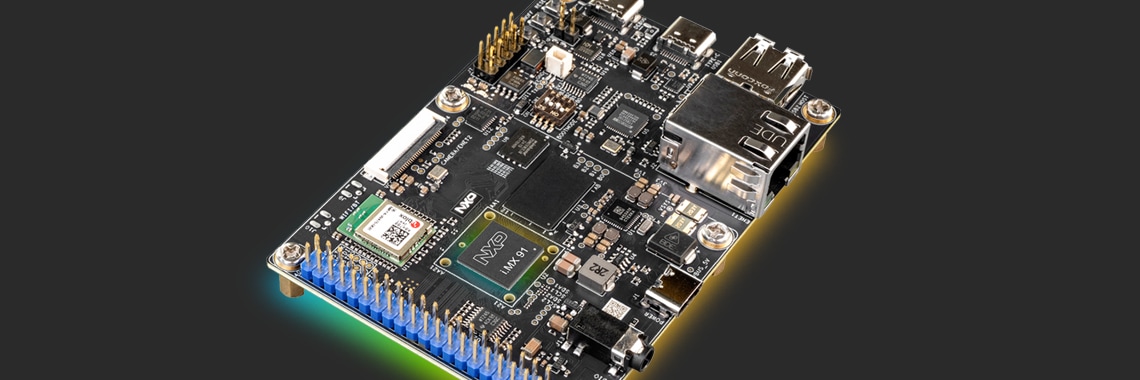
NXP's FRDM platform solution for accessible development tools bridges the gap between prototype and production. FRDM boards are designed with professional-grade capabilities in a cost-effective, easy-to-use format that accelerates the journey from concept to market. Choosing between the FRDM i.MX 93, FRDM i.MX 91 and FRDM i.MX 91S development platforms can be intimidating, but once you understand how each platform aligns with your application's requirements, the decision becomes straightforward.
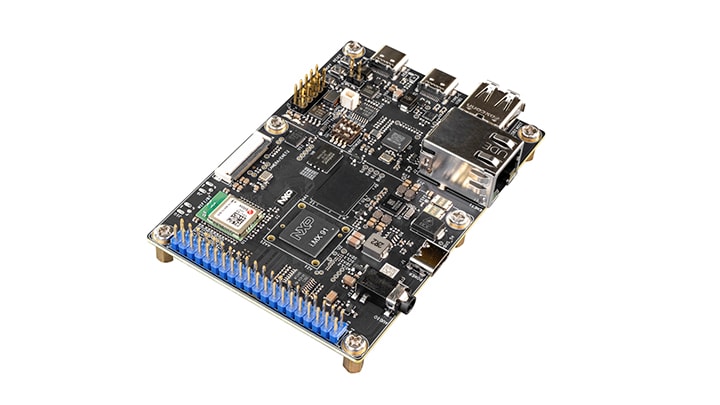 The FRDM i.MX 91S development platform is our entry into the FRDM i.MX 9 series development platform.
Overview of the FRDM i.MX 9 Series
Our FRDM i.MX 9 series is built on a scalable architecture foundation centered around the Arm® Cortex®-A55 processor core. This architecture provides the Linux®-capable processing power that defines the family's capabilities, while the inclusion of optional Cortex-M33 real-time cores and Neural Processing Unit (NPU) acceleration distinguishes the different family members. Pin compatibility between the i.MX 91 and i.MX 93 applications processors enables direct migration between these platforms without requiring printed circuit board (PCB) redesigns.
Accelerate your next design project with the right balance of performance and price.
Order a
FRDM i.MX 91S development platform and experience the FRDM to innovate.
Wireless connectivity also varies across the development platforms. The FRDM i.MX 9 series enables flexible and scalable prototyping for wireless connectivity with soldered-on u-blox modules that contain NXP's Wi-Fi 6 tri-radio solutions. The FRDM i.MX 91 board offers a MAYA-W4 module based on the IoT-optimized IW610 Family, while the FRDM i.MX 93 board hosts a MAYA-W2 module, based on IW612 Family for more advanced wireless capability.
Price Points vs. Performance Levels
At the entry level, the FRDM i.MX 91S is more affordable for basic Linux applications. It delivers full Linux capabilities at a price point that competes with many microcontroller development boards. At the next price point, the FRDM i.MX91 offers balanced performance with enhanced capabilities and expanded memory. This platform is suitable for projects that require more processing power or memory than the entry-level (FRDM i.MX 91S) platform provides, but don't need the advanced features that justify premium pricing. Finally, our premium FRDM i.MX 9 series platform (FRDM i.MX 93) offers maximum capability for the most demanding or complex applications with capabilities like AI acceleration, advanced multimedia support and heterogeneous processing.
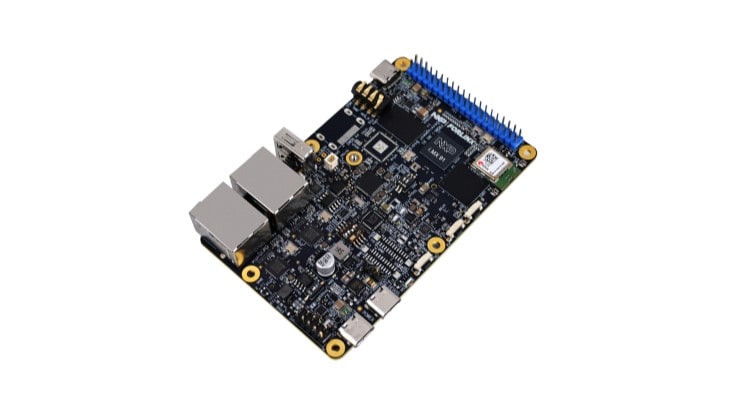 FRDM i.MX 91 development boards, balance price and performance within the FRDM i.MX 9 series.
How to Choose the Right Platform
To understand our three-platform approach, it's important to recognize that while there are three development boards, they're built around two distinct processors. The i.MX 91 applications processor powers both the FRDM i.MX 91S and FRDM i.MX 91 development platforms, while the more advanced i.MX 93 processor drives the FRDM i.MX 93 development platform. The i.MX 91 processor is built around a single Arm Cortex-A55 core optimized for efficiency and cost-effectiveness, making it ideal for applications that require Linux capabilities without the complexity of multicore processing.
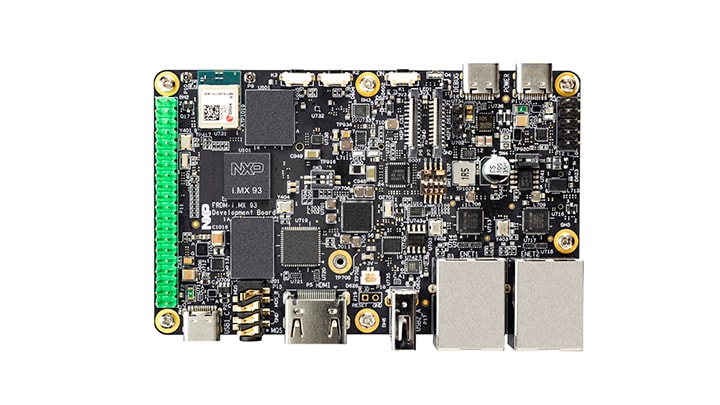 The FRDM i.MX 93 development board is the top-of-stack choice within the FRDM i.MX 9 series.
The key difference between the two i.MX 91-based platforms is their memory configurations and feature implementations, rather than their processing power. In contrast, the i.MX 93 processor offers two Cortex-A55 cores, plus a Cortex-M33 and NPU, creating a heterogeneous environment for handling simultaneous Linux applications, real-time tasks and AI workloads.
Understanding what you're building will guide you in choosing the appropriate platform for your development goals. Imagine you're building a basic environmental monitoring system that collects temperature, humidity and air quality data from multiple sensors then processes it locally, then transmits periodic reports to a cloud service. The FRDM i.MX 91S is ideal for such gateway functions since it offers a Linux stack and sensor interfaces for data collection and transmission. By selecting the processing power and features your application truly needs, you can avoid unnecessary costs.
On the other hand, if you're building a more complex system, such as an industrial automation controller, the FRDM i.MX 91 may be a better choice. It can manage machinery interfaces, process real-time sensor data and communicate with factory networks over Ethernet.
The FRDM i.MX 93 is the best choice for applications that require enhanced capabilities—such as an intelligent security camera system that captures high-resolution video, detects objects in real time and tracks movement using AI models.
Choose FRDM i.MX 91S if:
- You're on a strict budget
- Your application requires less than 512MB of memory
- You're developing basic gateway functions or simple interfaces
- You're migrating from microcontroller platforms where Linux networking is providing substantial benefits
Choose FRDM i.MX 91 if:
- Your application requires a balance between performance and features
- Networking capabilities are central to your requirements
- Audio evaluation and development are key project elements
- Your projects have outgrown basic requirements, but still don't need AI acceleration
Choose FRDM i.MX 93 if:
- Your application has AI and machine learning requirements
- Your application requires advanced multimedia capabilities
- Your application requires real-time processing
Software Support and Development Tools
The FRDM i.MX 91S runs a minimal Linux distribution designed to operate within 512MB memory constraints. The “S” in the part number denotes a simplified version of the FRDM i.MX 91 that maintains Linux capabilities with minimized resource requirements. This lightweight BSP includes only the essential drivers and libraries, offering a streamlined software foundation optimized for constrained environments. For developers and engineers, this means faster system bring-up, easier debugging, and greater flexibility to tailor the software stack to specific application needs. With fewer dependencies and reduced complexity, it accelerates development while ensuring efficient, reliable performance.
In contrast, FRDM i.MX 91 and FRDM i.MX 93 can run full Linux distributions with comprehensive feature sets. The i.MX 93 offers a comprehensive toolset, including specialized AI development features that support machine learning model development and deployment. The i.MX 91 offers graphical user interface (GUI) design tools and extensive support for applications that need complex user interfaces.
Updates and support are consistent across platforms, with each board receiving regular Linux updates following a unified schedule: twice yearly for Debian and once each year for Yocto.
Planning for Growth and Future Requirements
Strategic platform selection involves thinking beyond your immediate prototype to prepare for how your project might evolve. One approach is to start with the FRDM i.MX 91S for initial prototyping and proof-of-concept, then migrate into FRDM i.MX 91 or FRDM i.MX 93 when you need additional processing power, memory or advanced features.
The architectural relationship between platforms makes this growth strategy quite effective. For example, the i.MX 91 and i.MX 93 utilize the same pin layout, which means PCB designs can be transferred directly from one platform to the other.
Equally important is ecosystem compatibility across all three platforms. All FRDM i.MX 9 series boards utilize the same 40-pin connector interface, making your investment in expansion boards cost-effective as camera modules, displays and other accessories will work across the entire family.
FRDM to Innovate
FRDM i.MX 9 boards are an excellent solution for Linux-based embedded development through three strategically positioned platforms, each tailored to distinct performance, feature and cost requirements. The price differences between platforms allows you flexibility to choose the most capable option to accommodate your evolving needs.
Learn more about the expansive (and evolving) FRDM ecosystem on nxp.com.