We’re entering a new era of computing where intelligence lives at the edge—from factory robots to smart vehicles
assisting drivers, entertaining passengers and even helping with homework. Today’s AI must be local, responsive,
efficient and secure to meet the demands of real-time, on-device decision-making.
That’s why NXP is taking a major step forward. On October 27, 2025, we are excited to announce that we have
officially completed
the
acquisition of Kinara, one of the industry’s pioneers in high-performance, power-efficient Discrete Neural
Processing
Units (DNPUs).
Why It Matters
The future of intelligent systems is edge-centric. From predictive maintenance in factories to generative AI in smart
cameras, edge systems are now expected to handle complex inferencing workloads locally without relying on the cloud.
This shift brings compelling benefits: lower latency, improved data privacy, reduced bandwidth costs and enhanced
resiliency. But it also raises the bar for on-device compute performance and energy efficiency.
Meanwhile, the edge AI processing market is growing meteorically as developers seek secure, cost-effective and
power-efficient AI solutions. Omdia projected at the end of 2024 that the market for artificial intelligence
acceleration hardware at the edge, defined to include all compute above the microcontroller class and within 20 ms
network round-trip time from the user, would grow from $43 bn at year-end to $89.7 bn by 20291.
With the acquisition of Kinara, NXP boosts its portfolio with high-performance discrete NPUs and establishes a
scalable
platform for AI-powered edge systems. NXP will benefit from adopting Kinara’s AI engineers, who have extensive
experience in ML hardware, software stacks and application integration. Just as importantly, the acquisition adds
depth
to NXP’s software offering to support customers building production-ready solutions.
Discrete neural processing units reshape edge intelligence. Discover how NXP and Kinara are
advancing local AI in the
official press release to learn more.
The Edge Demands Highly Efficient and Scalable AI
Kinara’s flagship products, Ara-1 and Ara240, are
discrete NPUs designed to tackle the full spectrum of edge AI
workloads. Ara-1, the first-generation chip, delivers up to 6 eTOPS² and is already shipping in volume across
vision-centric edge use cases. Ara240, the second generation, is a powerhouse with up to 40 eTOPS² of performance and
optimized specifically for
generative AI, large language models (LLMs) , vision language models (VLMs), vision language action models (VLAs),
agentic AI and system-level acceleration.
With support for both convolutional neural networks (CNNs) and transformer-based architectures, Ara240 is built for
the
compute and memory bandwidth demands of modern AI. It excels in processing large language models and multimodal
applications, such as combining visual inputs with speech or text for context-aware inferencing.
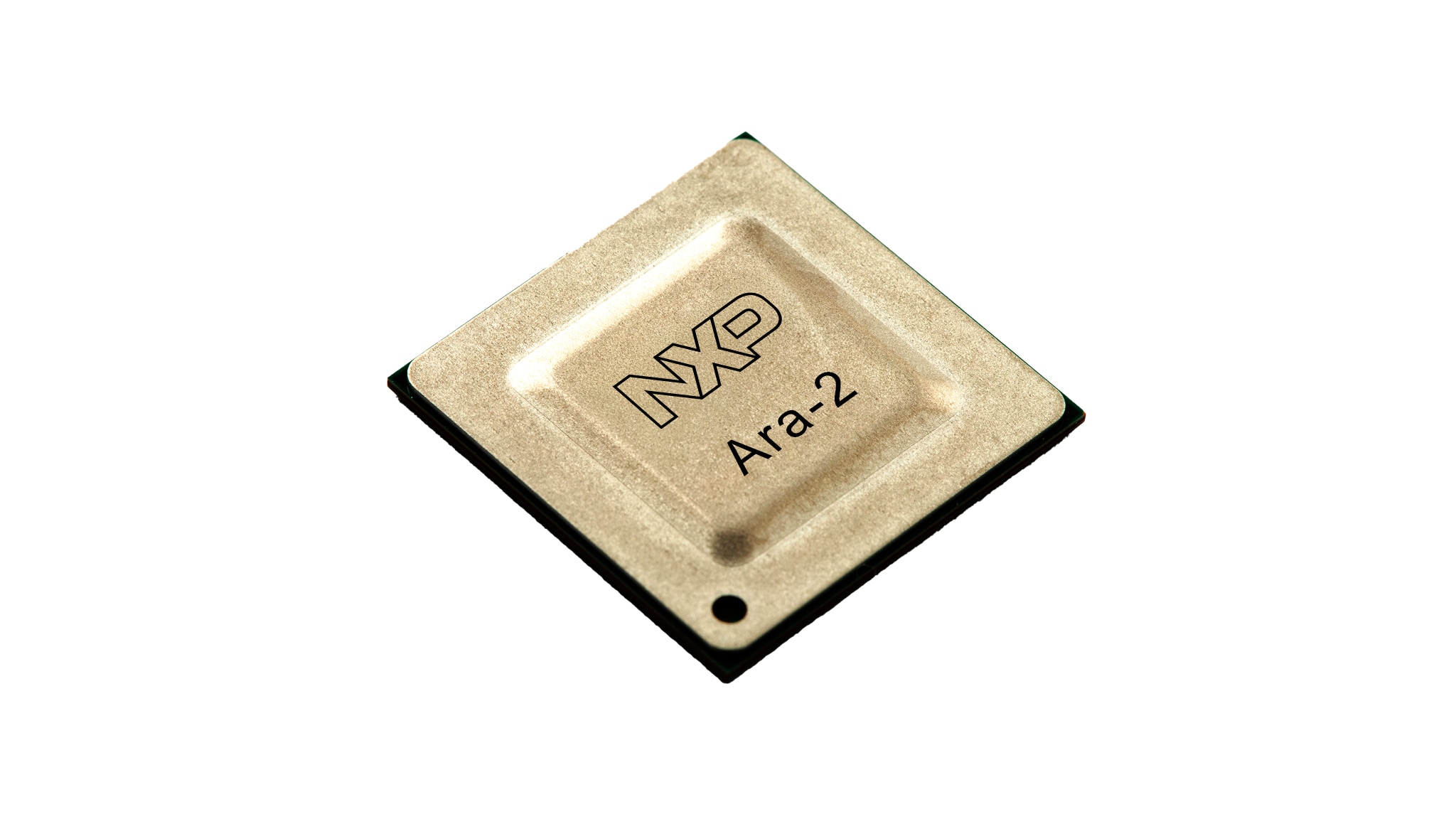 The Ara240 enables real-time Generative AI and LLM execution on AI-enabled compute
and embedded systems, delivering low
latency, lower operational costs and enhanced data privacy.
The Ara240 enables real-time Generative AI and LLM execution on AI-enabled compute
and embedded systems, delivering low
latency, lower operational costs and enhanced data privacy.
The architecture underpinning Ara-1 and Ara240 features a programmable, RISC-V-based dataflow design that allows
inference engines to be parsed and executed efficiently across proprietary multiply accumulate compute (MAC) units.
This
flexibility means that solutions can adapt as AI algorithms evolve, so engineers can handle today’s workloads and
adjust
to whatever the future has in store.
Why Kinara Complements NXP
Kinara’s value goes beyond its silicon. Its comprehensive AI software stack includes a software development kit
(SDK),
model optimization tools and an extensive library of preoptimized AI models. The Kinara SDK will be integrated into
NXP’s eIQ® SW development environment so that developers can build, optimize and deploy AI applications across the
combined portfolio with ease.
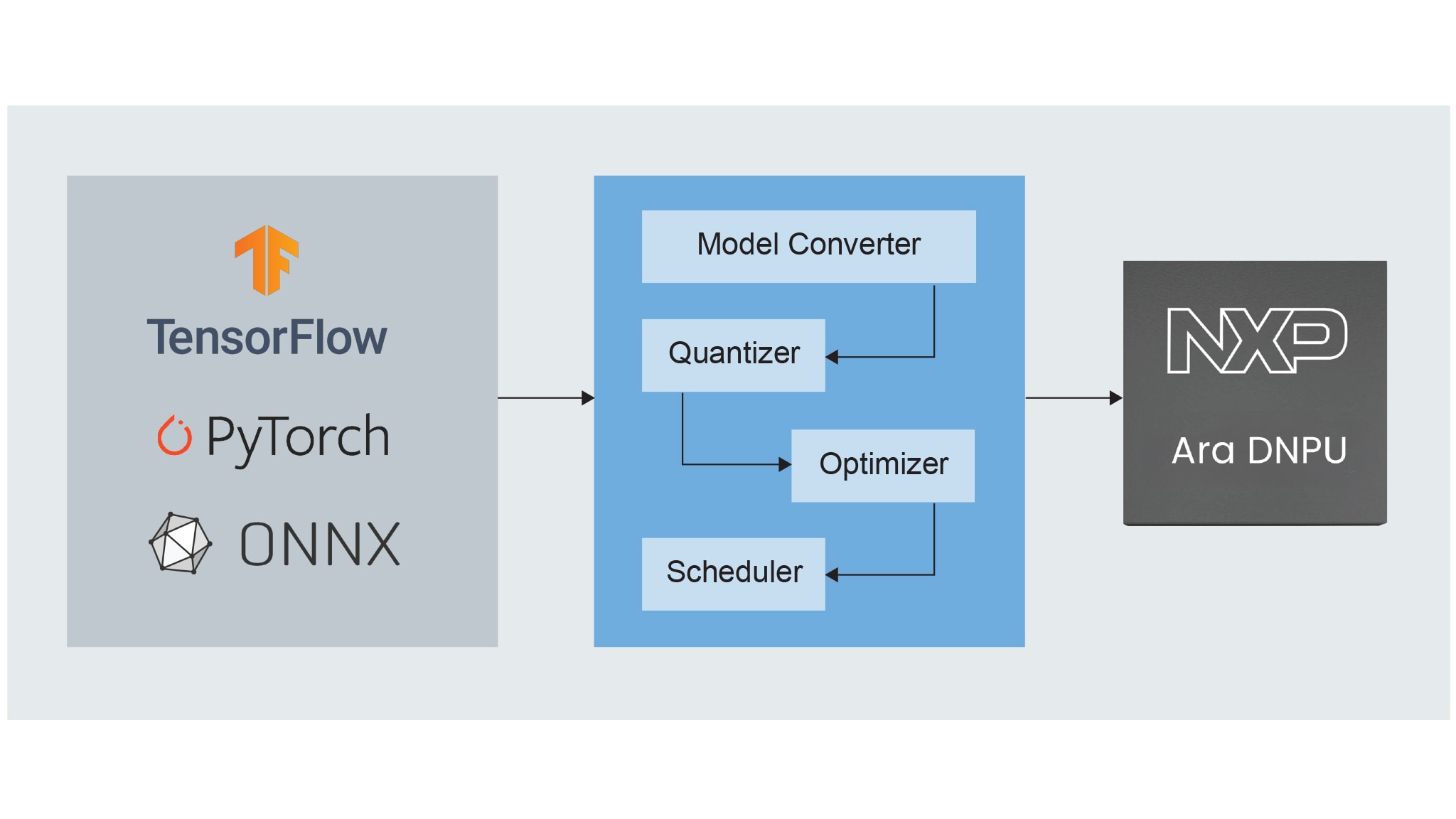 The comprehensive AI software stack includes a software development kit (SDK), model
optimization tools and an extensive
library of preoptimized AI models.
The comprehensive AI software stack includes a software development kit (SDK), model
optimization tools and an extensive
library of preoptimized AI models. For a better experience, download the
block diagram.
This unified tooling delivers a seamless and simplified user experience for developers. Whether building a smart
camera,
voice assistant, predictive maintenance engine or a multimodal human-machine interface, developers can now tap into
a
one-stop-shop experience. Our lineup of application processors, discrete NPUs, power management, security and
connectivity is all backed by differentiated software support.
And, Kinara’s Discrete NPUs pair naturally with NXP’s i.MX applications processors (MPUs), like the i.MX 8M Plus and
i.MX 95. In edge AI use cases, DNPU
accelerators will offload heavy inferencing tasks while the MPU can manage
preprocessing, postprocessing and general-purpose compute. Such synergy allows customers to scale AI performance
independently from the application processor and achieve system-level flexibility that meets any cost or power
budget.
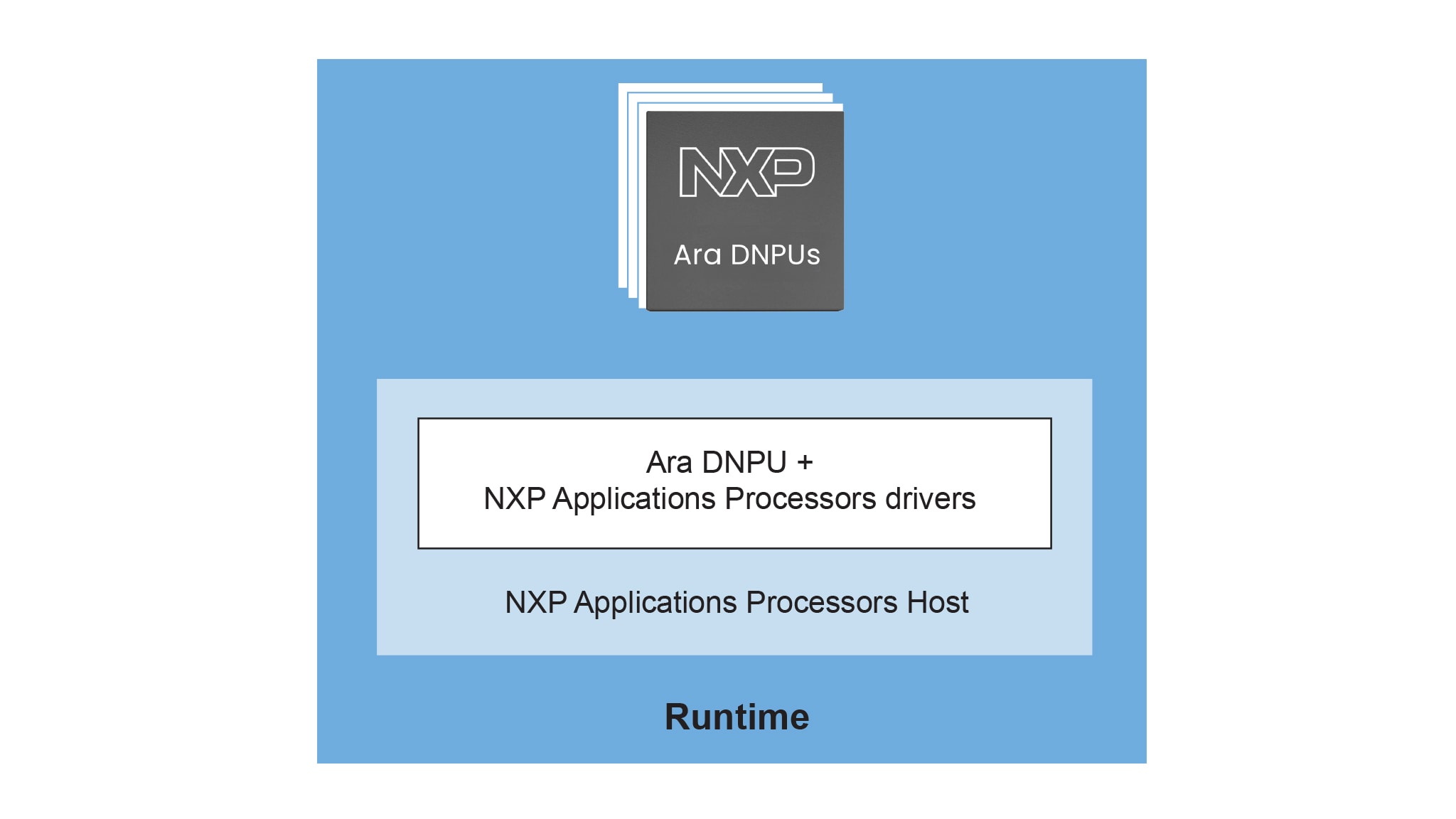 The acquisition enhances NXPs ability to provide complete and scalable AI
platforms, from TinyML to generative AI, by
bringing discrete NPUs and robust AI software to NXP’s portfolio of processors, connectivity, security and
advanced
analog solutions.
The acquisition enhances NXPs ability to provide complete and scalable AI
platforms, from TinyML to generative AI, by
bringing discrete NPUs and robust AI software to NXP’s portfolio of processors, connectivity, security and
advanced
analog solutions. For a better experience, download the
block diagram.
Finally, customers can have confidence knowing that Kinara has long been a member of the NXP Partner program and has
already demonstrated successful deployments with NXP applications processors.
Unleashing the Power of Gen-AI Together
By integrating Discrete NPUs to the portfolio, NXP can enable complex Generative AI and large language model tasks
to
run at the edge. Generative AI excels in real-time interpretation and reasoning on image and video, improving
clarity
and decision-making based on high-quality visuals. Ara DNPU devices’ ability to run multimodal LLM models extracting
features and contextual information from images and videos, utilizing text and voice inputs to perform tasks based
on
visual input, provides live analysis for applications such as monitoring the elderly, industrial safety analysis,
factory hazard detection and building or home security.
In retail settings, generative AI creates virtual showrooms or product designs tailored to individual customer
preferences. In manufacturing, DNPU solutions combined with generative AI and agentic AI drive efficiency, precision
and
adaptability, paving the way for innovative, targeted and autonomous applications across diverse industries.
Looking Ahead
The edge is evolving fast, as new AI use cases emerge every day. With the acquisition of Kinara, NXP now offers one
the
industry’s broadest portfolio of edge AI compute options covering
microcontrollers, applications processors and
discrete NPUs, so that customers can access full-stack solutions for any edge application. Through our holistic
offering, customers can reduce development time, minimize system complexity and focus on differentiating their AI
experiences from the competition.
1Omdia Market Radar: AI Processors for the Edge 2024, Alexander Harrowell, 23 April 2025.
²eTOPS = equivalent TOPS.