Author

Monica Cid
Mónica Cid has worked in Mass Market Marketing for 3 years, focus on developer journey for industrial and consumer processors and microcontrollers. She is based in Guadalajara, Jalisco, Mexico.
2025 was a defining year for the MCX microcontroller portfolio. Across industrial, IoT, consumer and emerging-edge markets. Developers are designing for greater intelligence, versatility and functional safety considerations—and MCX continues evolving to meet those needs. Built to support scalable development paths, the portfolio experienced a significant expansion this year, growing by nearly 90% as new devices were introduced across multiple series.
At the same time, our developer ecosystem advanced in step with the technology, offering clearer onboarding, enhanced tools and more hands-on evaluation options. With one of the largest expansions in the platform’s history arriving in 2026, MCX is poised for yet another transformative year ahead.
Throughout 2025, the MCX portfolio expanded substantially—adding eight new families across the MCX E, MCX A, MCX W, and MCX N series and extending the platform into even more application spaces.
Ready to get started? Explore our MCX portfolio.
The MCX E series—including the MCX E31 and MCX E24 families—brings 5V-capable, safety-minded and high-reliability microcontrollers into the MCX portfolio, designed for industrial automation, safe appliances and energy storage applications. These devices support developers who build systems that must operate dependably under harsh electrical conditions, elevated temperatures or long mission profiles.
The MCX E31 extends the MCX E series with a powerful Arm® Cortex®-M7-based microcontroller unit (MCU) designed for demanding industrial, energy and appliance systems that require fast control, long operating lifetimes and strong functional safety considerations. Its 5V-capable design, robust analog integration and built-in security through our EdgeLock® Secure Enclave make it well-suited for applications where reliable operation under harsh conditions is essential.
Ideal for advanced motor drives, power-conversion stages, industrial automation equipment, HVAC systems and long-lifecycle embedded products, the MCX E31 provides a dependable foundation for designs that must balance performance, safety and environmental resilience.
The MCX E24 brings rugged 5 V operation and safety-oriented architecture into a more compact, flexible MCU option for industrial and built-environment devices. With a Cortex-M4F core, real-time control peripherals and built-in diagnostics aligned to SIL2 capability, it supports applications that must remain dependable in noisy electrical conditions or variable environments.
Well-suited for industrial control nodes, pumps and fans, smart appliances, energy and power-management systems and edge devices that blend analog sensing with connected intelligence, the MCX E24 offers a resilient platform for developers who build reliable, safety-aware embedded systems.
The MCX A34 brings powerful mixed-signal capability and rapid-response control to the MCX portfolio. Built on an Arm Cortex-M33 with a high-speed Math Acceleration Unit (MAU), it delivers 17× faster trigonometric and reciprocal math, enabling a smoother and more responsive real-time control loops for motor-driven and precision-controlled applications. With rich analog integration, including analog-to-digital converters (ADCs), operational amplifiers (OpAmps), high-resolution pulse-width modulation (PWM)modules and flexible peripheral options, the MCX A34 helps developers simplify designs and consolidate external components.
Ideal for industrial motor control, smart appliances, robotics, renewable-energy systems and intelligent edge devices, the MCX A34 offers a balanced foundation for applications that demand accuracy, efficiency, and mixed-signal performance.
The MCX W series grew in 2025 with the addition of two new families—MCX W23 and MCX W72—bringing integrated, multiprotocol connectivity directly into the lineup. These new wireless MCUs combine secure Bluetooth® Low Energy (LE), Thread, Zigbee and Matter-capable radio subsystems with MCX compute and peripheral architectures, giving developers a fully integrated path to build connected devices without the need for an external wireless chipset. This expansion strengthens MCX’s role in IoT, smart-home and edge applications where size, efficiency and secure connectivity matter.
Together, the MCX W23 and MCX W72 families create a flexible range of wireless options. MCX W23 delivers ultra-low-power operation for compact, battery-powered sensors and small form-factor devices. MCX W72 offers higher compute capability with an Arm Cortex-M33 at 96 MHz, generous on-chip memory and a dedicated radio subsystem for more advanced, multiprotocol designs. What sets the MCX W72 apart is its advanced Bluetooth Channel Sounding capability—a feature introduced with Bluetooth 6.0. This technology enables secure and highly accurate ranging and localization that is crucial for applications like smart door locks, connected small appliances and home and building control devices.
With these two new families, the MCX W Series completes a key piece of the MCX expansion, providing developers with wireless-ready MCUs that support a wide variety of connected products—from simple IoT nodes to secure, feature-rich edge devices.
The MCX N series expanded in 2025 with new derivatives that give developers more flexibility to right-size features and better match mainstream embedded application needs. These new derivatives are built from the MCX N94 superset, which features ML acceleration with an embedded Neuronal Process Unit (NPU), advanced timers, rich analog capabilities, high-speed connectivity and advanced security for intelligent edge devices. Such additions provide more targeted options as the overall MCX portfolio continues to expand.
The update introduces two new dual-core series:
The MCX N24 family expands the single-core lineup with larger memory, versatile peripherals and integrated 10/100 Mbps Ethernet, enabling cost-effective designs for factory equipment and smart building applications.
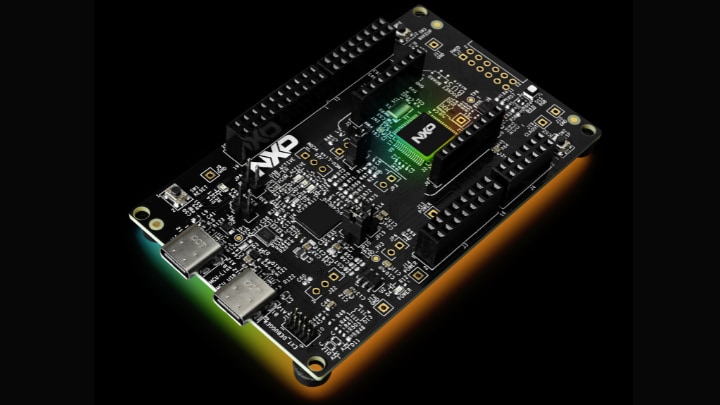
As the MCX portfolio grew, the surrounding developer experience advanced alongside it. In 2025, NXP focused on creating a more intuitive, example-driven and accessible ecosystem through:
These updates positioned MCX as a platform where developers can explore, learn and build with greater clarity and confidence.
MCX’s growth will continue beyond 2025 with more device launches. In 2026, the portfolio will expand even further with 12 new MCX families, giving developers more ways to scale designs and tailor capabilities to their applications. Alongside this growth, an entirely new series will debut: the MCX L Series, first announced at CES 2025 and built for ultra-low-power, always-on, battery-driven designs. With MCX L premiering alongside a broad set of new families, 2026 will mark one of the most significant expansion years in the MCX evolution.
Developers can also look forward to:
This expansion reflects NXP’s ongoing commitment to delivering a modern, unified MCU platform that progresses with the needs of developers.

As we close out a transformative year and prepare for yet another, one thing remains clear—the momentum behind MCX is strong. The nearly 90% portfolio growth achieved in 2025—paired with the significant expansion planned for 2026—demonstrates NXP’s focus on empowering developers with scalable microcontroller options and supportive tools.
The MCX journey continues in 2026. Discover the full MCX portfolio and start exploring the devices shaping the next generation of embedded.
Mónica Cid has worked in Mass Market Marketing for 3 years, focus on developer journey for industrial and consumer processors and microcontrollers. She is based in Guadalajara, Jalisco, Mexico.